Blog

Tuesday of Holy Week: What Jesus Chose to Say Before He Died

TruthLock™ Verified — GOLD/GREEN
Proof of Authentication — M88XVP2W
Share
Tuesday of Holy Week: What Jesus Chose to Say Before He Died

"He is not trying to scare them. He is trying to prepare them. There's a difference."

Was this helpful?

Most people who know the Easter story can tell you about Thursday and Friday. The Last Supper. Gethsemane. The cross. But ask them what Jesus was doing on Tuesday — two days before all of that — and you'll usually get silence.

That silence is a loss, because Tuesday of Holy Week may be the most concentrated day of teaching in all of scripture. And what Jesus chose to teach, knowing He had roughly seventy-two hours left, tells us something extraordinary about what mattered most to Him at the end.

A Man Walking Toward His Death on Purpose

Here's the setting. Jesus has already entered Jerusalem to shouts of Hosanna. He has already wept over the city. Luke records the rawness of that moment: "If thou hadst known, even thou, at least in this thy day, the things which belong unto thy peace! but now they are hid from thine eyes" (Luke 19:42). He has cleansed the temple. He has cursed a fig tree that bore no fruit — a living parable aimed straight at a nation that had all the outward signs of spiritual life but produced nothing.

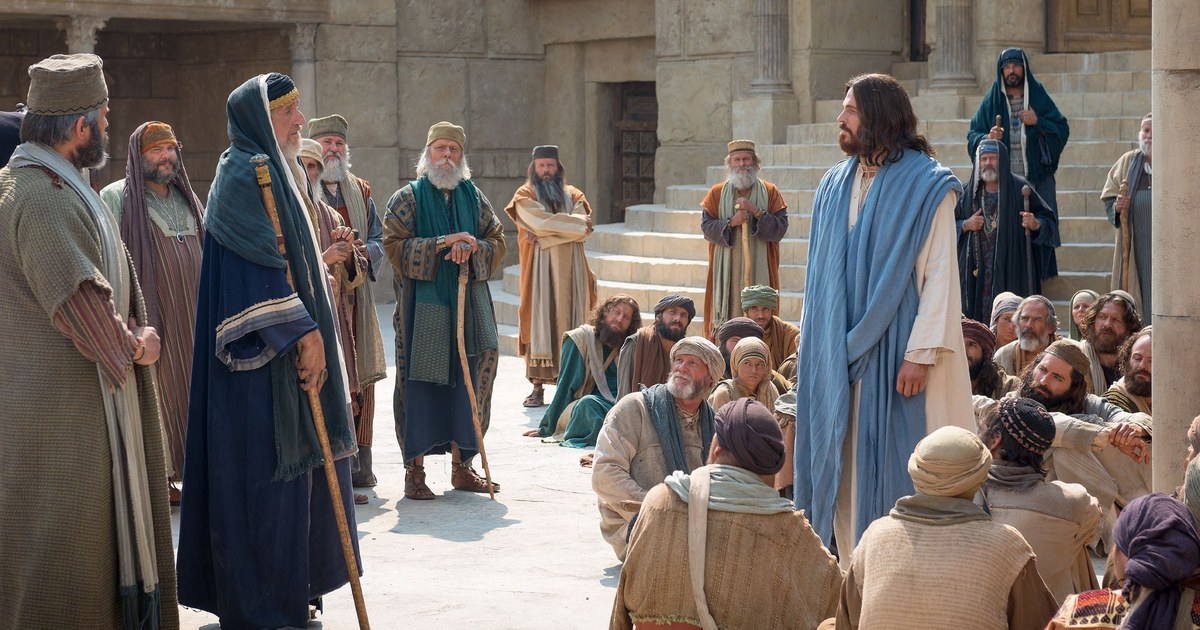
And now, on Tuesday, He walks back into the temple one more time. Not to hide. Not to escape. To teach. Every sentence He speaks is a sentence He has chosen over silence, knowing the cross is coming.

Think about that for a moment. If you had two days left and you had already said everything you needed to say, you'd stop talking. The fact that Jesus kept teaching — and taught more on this day than on almost any other recorded day of His ministry — means He hadn't said everything yet. Or perhaps more precisely, He hadn't said certain things loudly enough.

What He Chose to Say

The sheer volume of Tuesday's teaching is staggering. Matthew devotes chapters 21 through 25 largely to this day and its aftermath. Mark covers it from chapter 11:20 through chapter 13. Luke covers it in chapters 20 and 21. The New Testament Teacher Resource Manual charts it all: the confrontation with the chief priests over His authority, the parables of the two sons and the wicked husbandmen, the parable of the wedding feast, verbal sparring with Pharisees and Sadducees over tribute to Caesar and the resurrection, the great commandment, the denunciation of hypocrisy in Matthew 23, the widow's mite, and then — as He left the temple for the last time — the Olivet Discourse and the three great parables of Matthew 25.

That's an entire semester of institute in a single day.

But what strikes me is not the quantity. It's the arc. The day begins with confrontation and ends with tenderness. It begins with Jesus dismantling every pretender to authority and ends with Him on the Mount of Olives, privately telling His closest friends how the world will end and what they must do to survive it.

And right in the middle — the hinge of the whole day — is this:

"O Jerusalem, Jerusalem, thou that killest the prophets, and stonest them which are sent unto thee, how often would I have gathered thy children together, even as a hen gathereth her chickens under her wings, and ye would not!" (Matthew 23:37)

That verse is grief, not anger. A dying man looking at the people He came to save and saying, I tried. I tried so many times. And you wouldn't let me.

Then He turns His back on the temple forever.

The Olivet Discourse: Teaching Under a Deadline

As Jesus and His disciples walked away from the temple, the disciples did what any of us would do — they pointed out the buildings, the massive stones, the grandeur of it all. Jesus stopped them cold: "There shall not be left here one stone upon another, that shall not be thrown down" (Matthew 24:2).

That prophecy was fulfilled in A.D. 70 when Roman legions under Titus burned the temple and scattered its stones. Josephus estimated over a million Jews perished. The Christians in Jerusalem, however, remembered what Jesus had said. They fled to a town called Pella in the northern foothills of the Jordan Valley and survived. The words of a man they'd heard on a hillside forty years earlier literally saved their lives.

Sitting on the Mount of Olives afterward, the disciples asked the two questions that frame everything that follows: "When shall these things be?" and "What shall be the sign of thy coming, and of the end of the world?" (Matthew 24:3). The Joseph Smith Translation separates the answers more clearly than the King James Version does — Joseph Smith—Matthew 1:5–21 addresses the destruction of Jerusalem, and verses 22–55 address the Second Coming. Joseph Smith made more changes to Matthew 24 than to any other chapter in the New Testament, which tells you something about how much the original text had been muddled.

What Jesus tells them is unflinching. False Christs. Wars. Betrayal. The love of many waxing cold. But threaded through every warning is this refrain, spoken directly to His elect: "Behold, I speak these things unto you for the elect's sake; and you also shall hear of wars, and rumors of wars; see that ye be not troubled, for all I have told you must come to pass; but the end is not yet" (Joseph Smith—Matthew 1:23). And this: "But he that remaineth steadfast and is not overcome, the same shall be saved" (Joseph Smith—Matthew 1:11).

He is not trying to scare them. He is trying to prepare them. There's a difference.

Three Parables, One Question

Then come the three parables of Matthew 25, all delivered that same evening on the Mount of Olives. Elder Dale G. Renlund, in his April 2025 general conference address, described these as parables about "how to prepare to meet Him — whether at His Second Coming or whenever we leave this world." He's right. Each one asks a slightly different version of the same question: When the moment comes, will you be ready?

The parable of the ten virgins (Matthew 25:1–13) teaches that spiritual preparation cannot be borrowed. Oil — the kind that comes from years of quiet obedience, scripture study, repentance, and seeking the Spirit — cannot be transferred at the last minute. Five virgins had it. Five didn't. The door shut. The Doctrine and Covenants identifies the wise virgins as those who "have received the truth, and have taken the Holy Spirit for their guide, and have not been deceived" (D&C 45:57).

The parable of the talents (Matthew 25:14–30) teaches that God does not compare us to each other — but He does expect growth. The servant with five talents and the servant with two talents received identical praise: "Well done, thou good and faithful servant: thou hast been faithful over a few things, I will make thee ruler over many things: enter thou into the joy of thy lord" (Matthew 25:21). The same words. The same reward. The only servant condemned was the one who buried what he'd been given out of fear.

And then the sheep and the goats (Matthew 25:35–40). This one still gets me. Both groups — the sheep and the goats — are surprised by the verdict. The righteous don't remember serving Christ. The wicked don't remember neglecting Him. And that's the point. The judgment isn't about grand gestures anyone would notice. It's about the hungry person you fed without thinking about it, the stranger you welcomed without calculating the cost, the prisoner you visited when no one was watching. "Inasmuch as ye have done it unto one of the least of these my brethren, ye have done it unto me."

Why This Is an Easter Story

We tend to telescope Holy Week into two moments: the suffering and the empty tomb. But the Savior Himself spent His final days doing something else entirely. He was teaching. He was looking at a city that would reject Him, a temple that would be destroyed, a world that would descend into chaos, and disciples who would be scattered — and He was saying, Here is how you survive. Here is how you stay faithful. Here is what matters when everything else falls apart.

What mattered enough to say before He died?

Don't be deceived. Remain steadfast. Stand in holy places. Treasure up the word of God. Be watchful. Use what you've been given. And for the love of heaven, feed the hungry and visit the sick.

Not a single item on that list requires a theology degree. Not one requires wealth or status or a particular calling. Every one of them is available to every person reading this right now.

The next morning — Wednesday — the Gospels record nothing. Silence. As if Jesus, having poured out everything He had to say, simply rested. And then came Thursday, and the upper room, and a basin of water, and a new commandment: "That ye love one another; as I have loved you" (John 13:34).

And then came Friday. And then came Sunday.

But Tuesday — the day nobody talks about — is the day He told us what to do with the life His death would make possible. He walked toward His death on purpose. And He used every remaining hour to make sure we'd know how to walk toward our lives.

Discussion Questions

  1. If you had seventy-two hours left to teach the people you love, what would you choose to say — and what does Jesus's choice on Tuesday tell us about His priorities?
  2. The parable of the talents gives identical praise to the five-talent and two-talent servants. How does that change the way you think about comparing your efforts to others'?
  3. In the parable of the sheep and the goats, both groups are surprised by the verdict. What does it mean that the righteous didn't even remember serving Christ?
  4. Jesus's Tuesday arc moves from confrontation to tenderness — from dismantling hypocrisy to weeping over Jerusalem. What does that progression reveal about the nature of divine judgment?
Was this helpful?
← Back to all articles

TruthLock™ Verification

GOLD/GREEN
All 25 claims verified
Verified
Jesus taught extensively on Tuesday of Holy Week, the day before His arrest and crucifixion.
Multiple Church and external sources confirm that Tuesday of Holy Week was indeed a day of extensive teaching by Jesus — including parables, the Olivet Discourse, woes to the Pharisees, and teachings on the Mount of Olives — two days before His arrest on Thursday night and crucifixion on Friday.
Unknown
Jesus entered Jerusalem to shouts of Hosanna and wept over the city.
John 12:13 confirms the crowd cried 'Hosanna' at Jesus's entry into Jerusalem, but the evidence does not include a reference to Jesus weeping over the city.
Verified
Luke records Jesus saying 'If thou hadst known, even thou, at least in this thy day, the things which belong unto thy peace! but now they are hid from thine eyes' (Luke 19:42).
The evidence document from Luke 19:42 contains the exact quoted text attributed to Jesus, confirming the claim accurately.
Verified
Jesus cleansed the temple and cursed a fig tree that bore no fruit.
The claim is fully supported by scripture and Church sources: Matthew 21 and Mark 11 both record that Jesus cleansed the temple (casting out money changers) and cursed a barren fig tree that bore no fruit, causing it to wither.
Verified
Matthew devotes chapters 21 through 25 largely to Tuesday's teaching and its aftermath.
Multiple Church and external sources confirm that Matthew 21 through 25 is devoted largely to Tuesday's teaching during Holy Week, with the Tuesday section explicitly cited as Matthew 21:23–25:46 across several sources including a Church-affiliated event listing and The Gospel Coalition's Holy Week harmony.
Verified
Mark covers Tuesday's teaching from chapter 11:20 through chapter 13.
Multiple LDS and external sources confirm that Mark's account of Tuesday of Holy Week runs from Mark 11:20 through chapter 13 (specifically 11:20–13:37), exactly as the claim states.
Verified
Luke covers Tuesday's teaching in chapters 20 and 21.
Multiple sources confirm that Luke 20 and 21 cover Tuesday's teaching during Holy Week, including Jesus' authority challenged, parables, public debates, woes to scribes, the widow's offering, and the Olivet Discourse — all events traditionally assigned to Tuesday of Holy Week.
Verified
Jesus taught the confrontation with chief priests over His authority, parables of the two sons and wicked husbandmen, the parable of the wedding feast, and verbal sparring with Pharisees and Sadducees on Tuesday.
Multiple LDS and external sources confirm that Tuesday of Holy Week included the confrontation with chief priests over Jesus's authority (Matt 21:23-27), the parables of the two sons (Matt 21:28-32) and wicked husbandmen (Matt 21:33-46), the parable of the wedding feast (Matt 22:1-14), and verbal sparring with Pharisees and Sadducees (Matt 22:15-46), all of which are consistently placed on Tuesday in standard Holy Week chronologies.
Verified
Jesus taught about the great commandment, denounced hypocrisy in Matthew 23, and taught about the widow's mite on Tuesday.
Multiple LDS and external sources confirm that Tuesday of Holy Week was the day Jesus taught the great commandment (Matthew 22:34–40), denounced hypocrisy in Matthew 23, and observed the widow's mite (Mark 12:41–44), all of which are consistently placed on Tuesday in Holy Week chronologies from BYU's Religious Studies Center, the ESV Study Bible harmony, and The Gospel Coalition.
Verified
Jesus taught the Olivet Discourse and the three great parables of Matthew 25 as He left the temple for the last time.
Multiple LDS and external sources confirm that Jesus delivered the Olivet Discourse (Matthew 24–25) as He left the temple for the last time, going to the Mount of Olives, and that Matthew 25 contains the three great parables (ten virgins, talents, and sheep and goats) taught as part of that discourse — all consistent with the claim.
Verified
Matthew 23:37 records Jesus saying 'O Jerusalem, Jerusalem, thou that killest the prophets, and stonest them which are sent unto thee, how often would I have gathered thy children together, even as a hen gathereth her chickens under her wings, and ye would not!'
Matthew 23:37 in the evidence exactly matches the quoted text: 'O Jerusalem, Jerusalem, thou that killest the prophets, and stonest them which are sent unto thee, how often would I have gathered thy children together, even as a hen gathereth her chickens under her wings, and ye would not!'
Verified
Jesus prophesied that not one stone of the temple would be left upon another.
Matthew 24:2 records Jesus prophesying exactly this — 'There shall not be left here one stone upon another, that shall not be thrown down' — confirming both the prophecy and the text snippet 'There shall not be.'
Verified
The temple prophecy was fulfilled in A.D. 70 when Roman legions under Titus burned the temple and scattered its stones.
Multiple evidence sources confirm that Roman legions under Titus destroyed and burned the Jerusalem Temple in 70 A.D., with Josephus documenting the fire and the stones being dismantled to recover melted gold, fulfilling Jesus' prophecy that not one stone would be left upon another.
Verified
Josephus estimated over a million Jews perished in the destruction of the temple.
Source 1 confirms that Josephus reported 1.1 million casualties during the siege of Jerusalem, and Source 2's title references Josephus claiming over a million Jews were killed, consistent with the claim.
Verified
Christians in Jerusalem fled to Pella in the northern foothills of the Jordan Valley and survived the temple's destruction.
The claim is well-supported by both LDS and external historical sources: a 1989 Ensign article explicitly states that 'Extensive ruins of Pella lie near the modern village Tabaqat Fahl in the northern foothills of the Jordan Valley,' and that Christians fled there and survived the temple's destruction in AD 70, consistent with the accounts of Eusebius and Epiphanius.
Verified
The disciples asked Jesus 'When shall these things be?' and 'What shall be the sign of thy coming, and of the end of the world?' (Matthew 24:3).
Matthew 24:3 in the evidence confirms the disciples asked 'when shall these things be? and what shall be the sign of thy coming, and of the end of the world?' exactly as claimed.
Verified
The Joseph Smith Translation separates the answers in Matthew 24 more clearly than the King James Version, with Joseph Smith—Matthew 1:5–21 addressing the destruction of Jerusalem and verses 22–55 addressing the Second Coming.
Multiple official Church sources (New Testament Student Manual, Pearl of Great Price Student Manual, Scripture Helps, and Seminary Teacher Manual) explicitly confirm that the JST more clearly separates the two answers than the KJV, with JS—Matthew 1:5–21 addressing the destruction of Jerusalem and verses 22–55 addressing the Second Coming — exactly as the claim states.
Verified
Joseph Smith made more changes to Matthew 24 than to any other chapter in the New Testament.
The claim is confirmed verbatim by multiple official Church sources, including the Pearl of Great Price Student Manual and the Church's Scripture Helps for the New Testament, which state: 'The Prophet Joseph Smith made more changes to Matthew 24 than to any other chapter in the New Testament.'
Verified
Jesus told His disciples in Joseph Smith—Matthew 1:23: 'Behold, I speak these things unto you for the elect's sake; and you also shall hear of wars, and rumors of wars; see that ye be not troubled, for all I have told you must come to pass; but the end is not yet'.
Joseph Smith—Matthew 1:23 in the evidence exactly matches the quoted text: 'Behold, I speak these things unto you for the elect's sake; and you also shall hear of wars, and rumors of wars; see that ye be not troubled, for all I have told you must come to pass; but the end is not yet.'
Verified
Jesus told His disciples in Joseph Smith—Matthew 1:11: 'But he that remaineth steadfast and is not overcome, the same shall be saved'.
Joseph Smith—Matthew 1:11 in the evidence exactly matches the quoted text: 'But he that remaineth steadfast and is not overcome, the same shall be saved.'
Verified
Elder Dale G. Renlund described the three parables of Matthew 25 in his April 2025 general conference address as parables about 'how to prepare to meet Him — whether at His Second Coming or whenever we leave this world.'
The claim is confirmed verbatim: Elder Dale G. Renlund's April 2025 general conference address ('Personal Preparation to Meet the Savior') states that Jesus 'taught three parables, recorded in Matthew 25, about how to prepare to meet Him—whether at His Second Coming or whenever we leave this world,' matching the claim exactly.
Verified
The parable of the ten virgins teaches that spiritual preparation cannot be borrowed and oil cannot be transferred at the last minute.
The claim is fully supported by multiple official Church sources. Elder Marvin J. Ashton explicitly stated 'The oil of spiritual preparedness cannot be shared,' President Spencer W. Kimball taught that 'spiritual preparedness cannot be shared in an instant' and that 'No shortcut is available; no last-minute flurry of preparation is possible,' and Elder Bednar confirmed 'the oil of conversion cannot be borrowed' — all drawn directly from the parable of the ten virgins.
Verified
The Doctrine and Covenants identifies the wise virgins as those who 'have received the truth, and have taken the Holy Spirit for their guide, and have not been deceived' (D&C 45:57).
D&C 45:57 directly contains the quoted language describing those who are wise as having 'received the truth, and have taken the Holy Spirit for their guide, and have not been deceived,' which in context refers to the wise virgins parable.
Verified
The parable of the talents teaches that God does not compare us to each other but does expect growth.
Multiple official Church sources confirm both aspects of the claim: the parable of the talents teaches that God expects growth/use of gifts (not merely preservation), and Church leaders explicitly teach that God does not compare us to each other — Elder Quentin L. Cook states 'The growth in our own talents is the best measure of personal progress. Comparing blessings is almost certain to drive out joy,' and the seminary manual notes that the two servants received the same commendation despite having different amounts, emphasizing individual growth rather than comparison.
Verified
In the parable of the talents, the servant with five talents and the servant with two talents received identical praise: 'Well done, thou good and faithful servant: thou hast been faithful over a few things, I will make thee ruler over many things: enter thou into the joy of thy lord' (Matthew 25:21).
Matthew 25:21 in the evidence confirms the exact quoted praise, and the claim that both the five-talent and two-talent servants received identical praise is consistent with Matthew 25:21 and 25:23 (which uses the same wording), though only verse 21 is provided; the claim about identical praise is supported by the evidence for verse 21.
Learn more about TruthLock™ →