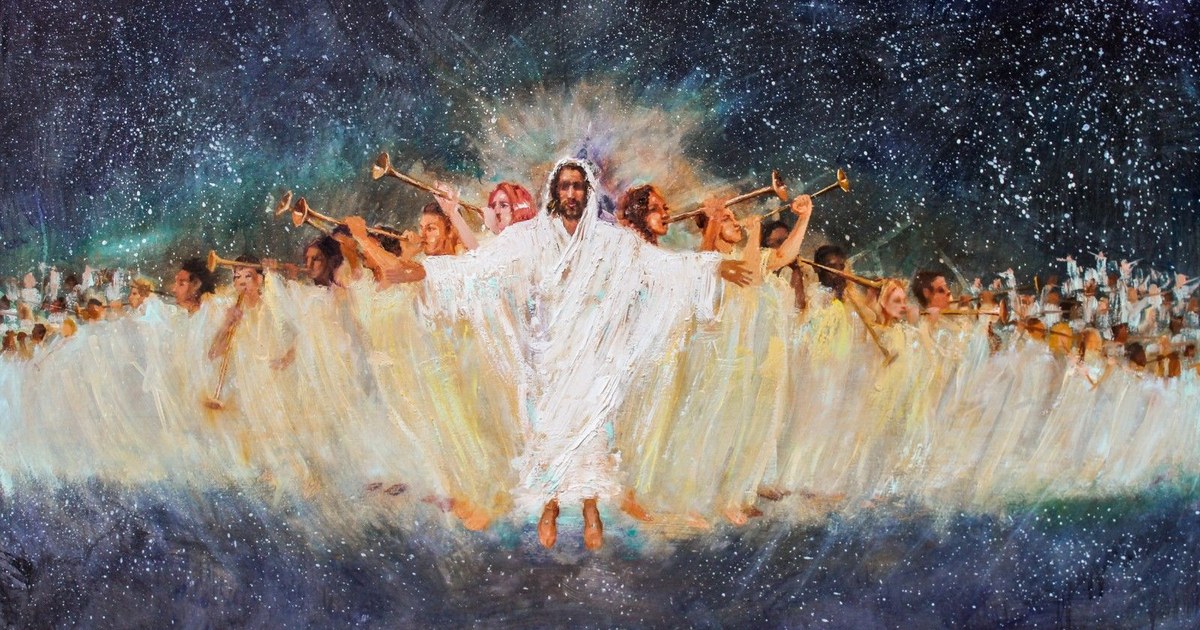
Somewhere between the headlines and the hymns, a lot of Latter-day Saints are carrying quiet dread. Not the dramatic, end-of-the-world kind — more the low-level hum that shows up when you scroll the news at midnight, or when a child asks at bedtime, "Is Jesus coming back soon? Should I be scared?" You don't always know what to say, because you've wondered the same thing.
The Second Coming is supposed to be the culmination of everything we believe. The whole point of the Restoration. And yet for many of us, the feelings it stirs are closer to anxiety than anticipation. We've heard about it in terms of destruction, tribulation, and judgment for so long that the word "preparation" starts to feel like bracing for impact.
But here's what I keep coming back to: the scriptures actually talk about the Second Coming in two radically different emotional registers, and which one applies depends entirely on the person hearing it.
The Two Registers
The Lord told His disciples in the Doctrine and Covenants, "Be not troubled, for, when all these things shall come to pass, ye may know that the promises which have been made unto you shall be fulfilled" (D&C 45:35). Be not troubled. That's a direct command, not a suggestion. And it comes embedded in the very revelation that catalogs wars, earthquakes, and hearts failing.
Then, just a few verses later, the Lord describes what the wise will look like at His coming: "They that are wise and have received the truth, and have taken the Holy Spirit for their guide, and have not been deceived — verily I say unto you, they shall not be hewn down and cast into the fire, but shall abide the day" (D&C 45:57).
Notice what makes someone "wise" in that formulation. It isn't stockpiling survival gear. It isn't decoding prophetic timelines. It's three things: receiving truth, taking the Holy Spirit as a guide, and not being deceived. That's a description of a way of living, not a checklist you complete the week before the world ends.
What Moroni Knew
The last verse of the Book of Mormon has always stopped me. Moroni, a man who watched his entire civilization destroy itself, who spent decades alone, who had every reason to be bitter or terrified — this man writes his farewell and describes the Final Judgment as "pleasing." He says he will be "brought forth triumphant through the air, to meet you before the pleasing bar of the great Jehovah" (Moroni 10:34).
Pleasing. Not terrifying. Not uncertain. Pleasing.
Elder David A. Bednar picked up on exactly this word in his October 2025 general conference talk. He observed that while some prophets describe Judgment Day with words like "shame and awful guilt" and "dread and fear," Moroni and others describe it as a "glorious day" to be anticipated with "an eye of faith." Elder Bednar's conclusion was striking: the doctrine of Christ is what enabled Moroni to look forward to that day with hopeful anticipation rather than dread. And then he asked the question that should follow us around for a while: "What did Moroni understand that you and I need to learn?"
Part of his answer: the Final Judgment won't look like a courtroom. We won't sit nervously waiting for a verdict to be read. Instead, "Ultimately, then, we are our own judges. No one will need to tell us where to go." That's either the most comforting or the most sobering sentence I've heard at general conference. Maybe both.
Confidence, Not Certainty
The gospel doesn't promise us certainty about when things will happen or exactly how. What it offers instead is something better: confidence in the presence of God. The Lord told Joseph Smith in Liberty Jail that when virtue garnishes our thoughts and charity fills our hearts, "then shall thy confidence wax strong in the presence of God" (D&C 121:45).
President Russell M. Nelson returned to this very verse in his April 2025 conference address, and he reframed it in a way I found deeply practical. He said this confidence isn't just about the future — it's about approaching God right now. "I am referring to praying with confidence that Heavenly Father hears us, that He understands our needs better than we do. … He loves us more than we can comprehend." And then he connected it directly to preparation for the Second Coming: "I do know that the Lord is prompting me to urge us to get ready for that 'great and dreadful day.'"
That pairing matters. President Nelson didn't say, "Be afraid and get ready." He said, "Grow in confidence and get ready." Those are fundamentally different postures. One clenches. The other opens.
The Formula That Isn't a Formula
The most-quoted scripture on this subject is also the most misunderstood: "If ye are prepared ye shall not fear" (D&C 38:30). We tend to read it as a conditional threat — if you're prepared, you won't fear; therefore, if you do fear, you must not be prepared. That reading produces exactly the anxiety it's supposed to cure.
But look at the verse in its full context. The Lord is speaking to Saints who have just prayed for guidance. He's responding to their prayers. And his counsel is to "treasure up wisdom in your bosoms." The preparation He's describing isn't a state of flawless readiness. It's an orientation — a life pointed toward wisdom, toward light, toward Him. And the promise is that this orientation displaces fear. Not because you've checked every box, but because you've built a relationship with someone you trust.
Then-Elder Dallin H. Oaks made a penetrating observation in his April 2004 conference talk on this subject. He noted that spiritual preparation is "the one less visible and more difficult" and warned that "a 72-hour kit of temporal supplies may prove valuable for earthly challenges, but … a 24-hour kit of spiritual preparation is of greater and more enduring value." He then asked a question that cuts straight through every procrastination: "What if the day of His coming was tomorrow? … If we knew that we would meet the Lord tomorrow — through our premature death or through His unexpected coming — what would we do today? … If we would do those things then, why not now?"
That's the whole thing, really. Why not now?
What Love Does to Fear
John the Beloved wrote the simplest and most radical thing ever said about fear: "There is no fear in love; but perfect love casteth out fear: because fear hath torment" (1 John 4:18). The antidote to fear isn't more information about the signs of the times. It isn't a better emergency plan. It's love — love for God, love received from God, love given to the people around you.
This is the distinctive thing the restored gospel offers. Other traditions frame the end times as a puzzle to solve or a horror to endure. The Restoration frames it as a reunion. The Bridegroom is coming, and the whole of our preparation is really just learning to love Him before we see Him — and to love each other while we wait.
"He who doeth the works of righteousness shall receive his reward, even peace in this world, and eternal life in the world to come" (D&C 59:23). Peace in this world. Not just after Christ returns — now. The preparation and the reward are not entirely sequential. Living the gospel is supposed to produce peace as you go.
President Nelson said it plainly in his October 2024 conference address: "The best is yet to come, my dear brothers and sisters, because the Savior is coming again! The best is yet to come because the Lord is hastening His work. The best is yet to come as we fully turn our hearts and our lives to Jesus Christ." That's not the language of dread. That's the language of a man who has spent a century on this earth and still calls what's ahead the best.
Something to Do This Week
If the low hum of anxiety is familiar to you — if you carry some version of dread about the future, about the state of the world, about whether you're "ready enough" — here's what I'd offer. Don't start with the signs of the times. Start with the relationship.
Pray this week with the assumption that God is glad to hear from you. Read a chapter from the Gospels and notice how Jesus actually treated the people who came to Him unready, unfinished, afraid. Go to the temple if you can, not to check a box but to sit in a place where the noise stops. Do one thing that requires charity — real charity, the kind that costs you something.
And when that child asks at bedtime whether they should be scared, tell them the truth: that the person coming is someone who loves them. That He's not coming to catch us off guard — He's coming to bring us home. That preparation isn't panic; it's just learning to recognize His voice so well that when He arrives, it feels like what it is.
A reunion.
Art credit: Des Leavitt