She came while it was still dark.
That detail — so small, so easily skipped — is the one that stops me every time I read it. John records that Mary Magdalene came to the sepulchre on "the first day of the week … early, when it was yet dark" (John 20:1). She did not wait for the sun. She did not wait for courage. She did not wait for the other disciples to organize a plan. She went while it was still dark, because the person she loved was in that tomb, and she could not stay away.
Think about what Mary carried with her through that predawn walk. She had watched Him die. She had stood near the cross — John places her there alongside His mother (John 19:25). She had seen His body taken down, wrapped in linen, laid in a borrowed tomb. She had observed where they put Him (Mark 15:47). She had endured Saturday — that long, silent, impossible day we wrote about yesterday — and now, at the earliest possible moment, she was going back. Not because she expected a miracle. Because she loved Him. Mark tells us she and the other women had bought spices to anoint His body (Mark 16:1). They were going to do the only thing left to do for someone you love after they have died: tend to the body.
Mary went to the tomb expecting death. She found something else entirely.
The Stone Was Already Gone
When she arrived, the stone had been rolled away. Matthew tells us an angel of the Lord had descended and moved it, and that the Roman guards shook with fear and "became as dead men" (Matthew 28:2–4). But Mary seems not to have seen the angel — or if she did, what registered first was the absence. The body was gone. Her Lord was gone. And the only explanation her grieving mind could construct was theft: "They have taken away the Lord out of the sepulchre, and we know not where they have laid him" (John 20:2).
She ran to Peter and John. They came running. John outran Peter — a detail so humanly specific that it reads like an eyewitness account, because it is. They saw the linen clothes lying there, and the napkin that had been around His head, folded and set apart by itself (John 20:6–7). John "saw, and believed" — though the text adds, almost parenthetically, that "as yet they knew not the scripture, that he must rise again from the dead" (John 20:8–9). Something was breaking through, but they could not yet name it.
Then the two apostles went home. And Mary stayed.
She Stayed
This is the detail that most people miss, and it is the hinge on which the entire Easter narrative turns. Peter and John left. Mary did not. She stood outside the sepulchre, weeping. And as she wept, she stooped down and looked into the tomb one more time.
Two angels in white were sitting there — one at the head and one at the feet where the body of Jesus had lain. They asked her, "Woman, why weepest thou?" And she gave them the same answer she had given Peter and John: "Because they have taken away my Lord, and I know not where they have laid him" (John 20:12–13).
Even two angels could not break through her grief. She was not looking for a miracle. She was looking for a body.
And then she turned.
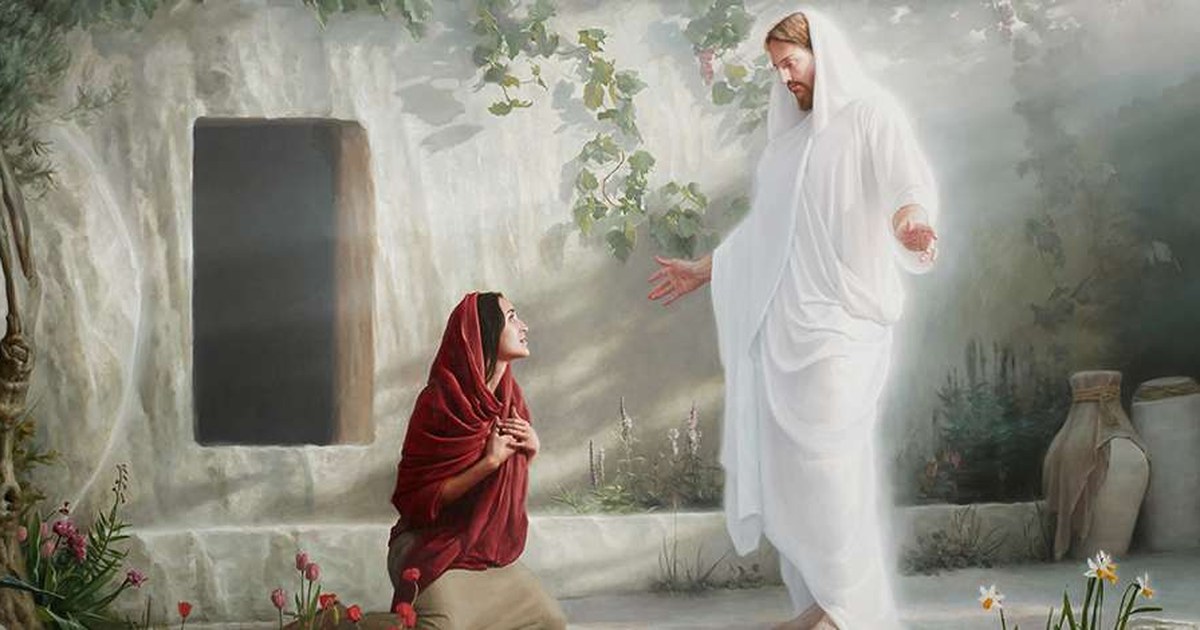
Someone was standing behind her. He asked the same question the angels had asked — "Woman, why weepest thou?" — and added one more: "Whom seekest thou?" Mary, supposing Him to be the gardener, said, "Sir, if thou have borne him hence, tell me where thou hast laid him, and I will take him away" (John 20:15).
Think about what she just offered. She — a woman in first-century Palestine, with no social standing and no physical means — offered to carry the dead weight of a grown man's body by herself. She did not calculate whether it was possible. She simply wanted Him back. She would figure out the rest.
And then He said one word.
"Mary."
That was all. Her name, spoken in a voice she thought she would never hear again. And she knew. Elder James E. Talmage wrote of this moment with characteristic precision: "One word from His living lips changed her agonized grief into ecstatic joy. … The voice, the tone, the tender accent she had heard and loved in the earlier days lifted her from the despairing depths into which she had sunk." She turned and cried out, "Rabboni" — Master (John 20:16).
He was alive. Not metaphorically. Not spiritually. Not in some reduced, symbolic sense that modern sensibilities might find more comfortable. He was standing in front of her in a garden, in the early morning light, calling her by name.
Why Her?
It is worth pausing to ask why the resurrected Lord — the God of heaven and earth, the Creator of worlds without number — chose Mary Magdalene as the first mortal witness of His Resurrection. Not Peter, the chief Apostle. Not John, the Beloved. Not His own mother. A woman from Magdala, from whom He had once cast seven devils, who had followed Him and ministered to Him and stood by Him when nearly everyone else had fled.
The answer, I think, is embedded in the story itself. She was there. She came while it was still dark. She stayed when Peter and John went home. She kept looking when there was nothing left to see. And because she stayed — because love held her at that tomb when reason and grief told her to leave — she was in the right place at the right time to hear her name spoken by the risen Christ.
A recent Liahona article on Mary Magdalene captured this perfectly: "It was love, not knowledge, that brought her to the tomb, and love kept her there. And because she stayed, she was in the right place at the right time to receive the answers she needed when they finally came."
There is a sermon in that sentence for every person who has ever waited in the dark.
The Day the World Changed
What happened that Sunday morning was not merely the resuscitation of a corpse. It was not Lazarus emerging from the tomb still wrapped in graveclothes, still mortal, still destined to die again. This was something that had never happened before in the history of the universe. A glorified, immortal Being — with a body of flesh and bone that could be touched and felt and that bore the marks of His sacrifice — stood in a garden and spoke a woman's name. And in that single act, every law of death was broken.
Paul stated the implications with breathtaking clarity: "But now is Christ risen from the dead, and become the firstfruits of them that slept. For since by man came death, by man came also the resurrection of the dead. For as in Adam all die, even so in Christ shall all be made alive" (1 Corinthians 15:20–22).
All. Not some. Not the righteous only. All. The Resurrection is not a reward for good behavior. It is a gift — universal, unconditional, and absolute. Every person who has ever drawn breath will be raised from the dead because of what happened in that garden. Amulek taught that "the spirit and the body shall be reunited again in its perfect form; both limb and joint shall be restored to its proper frame … and even there shall not so much as a hair of their heads be lost; but every thing shall be restored to its perfect frame" (Alma 11:43–44).
Every limb. Every joint. Every hair. The child who died before she could walk. The soldier whose body was never recovered. The grandmother whose mind faded year by year until the woman her family knew seemed to vanish behind a wall of confusion. All of them — all of us — will be restored to a perfect frame. That is the promise of Easter morning, and it rests on the physical, literal, historical fact that Jesus Christ walked out of a tomb.
He Kept Appearing
What strikes me about the rest of that first Easter Sunday is how relentless the risen Christ was in making Himself known. He did not appear once and ascend. He appeared again and again — to different people, in different settings, in different states of belief.
Later that day, two disciples were walking the road to Emmaus, about seven miles from Jerusalem. They were talking about everything that had happened — the arrest, the crucifixion, the rumors of an empty tomb — and "Jesus himself drew near, and went with them. But their eyes were holden that they should not know him" (Luke 24:15–16). He walked beside them for miles. He listened to their grief. He opened the scriptures to them, beginning at Moses and all the prophets, and expounded "the things concerning himself" (Luke 24:27). And when they sat down to eat and He broke the bread, "their eyes were opened, and they knew him" (Luke 24:31). Then He vanished. And they said to each other the words that have echoed through every generation since: "Did not our heart burn within us, while he talked with us by the way, and while he opened to us the scriptures?" (Luke 24:32).
That evening, He appeared to the disciples behind shut doors. John records that the doors were closed "for fear of the Jews" when Jesus came and stood in their midst (John 20:19). Luke tells us they were terrified and "supposed that they had seen a spirit" (Luke 24:37). John records that He showed them His hands and His side (John 20:20). Luke adds that He showed them His hands and feet and ate broiled fish in front of them (Luke 24:39–43). He breathed on them and said, "Receive ye the Holy Ghost" (John 20:19–22).
Thomas was not there that night. When the others told him, he said the thing that honest doubters have always said: "Except I shall see in his hands the print of the nails, and put my finger into the print of the nails, and thrust my hand into his side, I will not believe" (John 20:25). Eight days later, Jesus came again — the doors still shut — stood in the midst, and said to Thomas: "Reach hither thy finger, and behold my hands; and reach hither thy hand, and thrust it into my side: and be not faithless, but believing." And Thomas — the man we have unfairly called "Doubting Thomas" for two thousand years — gave the most theologically precise declaration of any mortal in the Gospels: "My Lord and my God" (John 20:27–28).
Then Jesus said the words that reach across the centuries and land directly in our laps: "Thomas, because thou hast seen me, thou hast believed: blessed are they that have not seen, and yet have believed" (John 20:29).
That is us. We are the ones who have not seen. And we are the ones He calls blessed.
The Other Hemisphere
But the story does not end in Jerusalem. And this is where the Restoration adds something that no other Christian tradition possesses — a second witness so detailed, so tender, so physically specific that it changes the way you read the Gospels forever.
In the land Bountiful, a multitude of about twenty-five hundred people gathered near the temple. They had survived the catastrophic destructions that accompanied the Savior's death — the earthquakes, the fires, the three days of suffocating darkness. They were conversing about Jesus Christ when they heard a voice from heaven. It was not loud. It was not harsh. It was small — and yet "it did pierce them that did hear to the center, insomuch that there was no part of their frame that it did not cause to quake; yea, it did pierce them to the very soul, and did cause their hearts to burn" (3 Nephi 11:3).
Twice they heard the voice and did not understand it. The third time, they opened their ears. They looked toward heaven. And the voice said: "Behold my Beloved Son, in whom I am well pleased, in whom I have glorified my name — hear ye him" (3 Nephi 11:7).
Then they saw a Man descending out of heaven, clothed in a white robe. He came down and stood in their midst. And He said: "Behold, I am Jesus Christ, whom the prophets testified shall come into the world. And behold, I am the light and the life of the world; and I have drunk out of that bitter cup which the Father hath given me, and have glorified the Father in taking upon me the sins of the world" (3 Nephi 11:10–11).
The whole multitude fell to the earth. And then He invited them forward — not as a crowd, not en masse, but one by one: "Arise and come forth unto me, that ye may thrust your hands into my side, and also that ye may feel the prints of the nails in my hands and in my feet, that ye may know that I am the God of Israel, and the God of the whole earth, and have been slain for the sins of the world" (3 Nephi 11:14).
Twenty-five hundred people. One by one. Each person went forward and felt the wounds in His hands and His feet and His side. Each one knew for themselves. And when they had all gone forth, they cried out with one voice: "Hosanna! Blessed be the name of the Most High God!" And they fell at His feet and worshipped Him (3 Nephi 11:15–17).
One by one. That is how He works. That is how He has always worked. He took their little children, "one by one, and blessed them, and prayed unto the Father for them" (3 Nephi 17:21). The God of the universe, who had just conquered death itself, wept as He held each child. The Resurrection did not make Him less tender. It made His tenderness eternal.
What the Resurrection Means for You
Elder D. Todd Christofferson, in his April 2014 general conference address, drew a line from the fact of the Resurrection to every question that haunts the human heart: "If Jesus was in fact literally resurrected, it necessarily follows that He is a divine being. No mere mortal has the power in himself to come to life again after dying. Because He was resurrected, Jesus cannot have been only a carpenter, a teacher, a rabbi, or a prophet. Because He was resurrected, Jesus had to have been a God, even the Only Begotten Son of the Father." And then, with the precision of a lawyer building a case: "Therefore, what He taught is true; God cannot lie. … Therefore, there is a resurrection and a final judgment for all." The Resurrection is not merely an article of faith. It is the load-bearing wall. Remove it and everything collapses. Leave it in place and everything — the Atonement, the plan of salvation, the sealing power, the promise of eternal families — holds.
This is why Elder Jeffrey R. Holland, in his April 2009 general conference address, could close the arc of Holy Week with a single sentence that captures everything this series of posts has been building toward: "Against all odds and with none to help or uphold Him, Jesus of Nazareth, the living Son of the living God, restored physical life where death had held sway and brought joyful, spiritual redemption out of sin, hellish darkness, and despair."
Thursday He descended from Master to servant to sacrifice. Friday He was forsaken. Saturday He was silent — or so it seemed, while behind the sealed stone He was organizing the greatest rescue in history. And Sunday He rose. The descent was complete. The ascent had begun. And it has not stopped.
Sunday Is Here
This whole week we have been walking toward this morning. From the palms on Sunday to the cleansing on Monday, from the parables on Tuesday to the anointing on Wednesday, from the upper room on Thursday to the cross on Friday, from the sealed tomb on Saturday to this — the first light of Sunday, and a woman weeping in a garden, and a voice saying her name.
If you are in the dark right now — if the diagnosis has not changed, if the marriage has not healed, if the child has not come home, if the grief is so heavy you can barely stand — I want you to hear what Mary heard. Not the theology. Not the doctrine. Just the voice. Just your name, spoken by someone who knows you completely and loves you anyway. Someone who bled for your specific sorrow in a garden and died on a cross for your specific sins and walked out of a tomb on a Sunday morning so that every broken thing in your life could be made whole.
He is not in the tomb. He was never going to stay there. The stone was rolled away not to let Him out — He did not need anyone to open the door — but to let us look in and see that it was empty.
Elder Gerrit W. Gong, in his April 2025 general conference address, spoke of Easter with the kind of tenderness that only comes from someone who has wept alongside the grieving: "This is Easter in Jesus Christ: He answers the longings of our hearts and the questions of our souls. He wipes away our tears, except our tears of joy." And then: "With Easter joy, we sing, 'Death is conquered; man is free. Christ has won the victory.'"
That is the message of this morning. Not that suffering is imaginary. Not that grief is inappropriate. Not that the darkness was not real. It was real. Friday was real. Saturday was real. The nails were real. The silence was real. But Sunday is also real. And Sunday has the final word.
Mary came to the tomb while it was still dark. She left in the light. And she carried with her the most important message any human being has ever delivered: "I have seen the Lord" (John 20:18).
He is risen. He is risen indeed.