Before the bread is broken, before the basin is filled, the Gospel of John frames the most sacred night in human history with a single sentence that reads like a thesis for everything that follows: "Having loved his own which were in the world, he loved them unto the end" (John 13:1). Most of us read "unto the end" as a statement about duration — He loved them all the way to the finish. And it is that. But the Greek carries a second meaning: He loved them to the uttermost. To the limit. To the bottom.
Thursday of Holy Week is the night we discover what "to the uttermost" actually looks like. And it looks like descent.
They Were Still Arguing
Here is the detail that most members of the Church have never noticed, and once you see it, you cannot unsee it. Luke records that at the Last Supper — at this sacred Passover meal, on the night Jesus would bleed from every pore — "there was also a strife among them, which of them should be accounted the greatest" (Luke 22:24).
Read that again. They were arguing about rank. At the table. That night.
This was not the first time. They had argued about it on the road to Capernaum. James and John had lobbied for the best seats in the kingdom. But this — this was the night before Calvary. The bread of the new covenant was about to be broken. The cup of His blood was about to be poured. And the Twelve were jockeying for position like men angling for a promotion.
Jesus responded — but not with a lecture. Luke records His words: "The kings of the Gentiles exercise lordship over them; and they that exercise authority upon them are called benefactors. But ye shall not be so: but he that is greatest among you, let him be as the younger; and he that is chief, as he that doth serve. For whether is greater, he that sitteth at meat, or he that serveth? is not he that sitteth at meat? but I am among you as he that serveth" (Luke 22:25–27).
And then He stood up from the table and showed them what those words meant with His body.
The First Descent: Master to Slave
John tells it with devastating precision. Watch the sequence: "Jesus knowing that the Father had given all things into his hands, and that he was come from God, and went to God; He riseth from supper, and laid aside his garments; and took a towel, and girded himself. After that he poureth water into a basin, and began to wash the disciples' feet" (John 13:3–5).
Notice what John does. He front-loads the sentence with the highest possible claim — Jesus knew that He had come from God, that He was going to God, that all things had been given into His hands. He is the Creator of worlds. He is the Firstborn of the Father. He holds all power.
And then: He laid aside His garments. Took a towel. Poured water. Knelt.
The juxtaposition is intentional. John is saying: this is what omnipotence looks like when it loves. It strips itself. It kneels. It takes the form of the lowest servant in the household.
In the ancient world, foot washing was not merely humble — it was the task assigned to the lowest-ranking servant. Even among slaves, it was the job given to the one at the bottom. Masters did not wash servants' feet. Teachers did not wash students' feet. Rabbis certainly did not wash their disciples' feet. The Church's New Testament Student Manual notes that "this custom of hospitality was usually performed by the lowest level of servants." When Jesus wrapped that towel around His waist, every person in the room understood what He was saying without words: I am taking the position that none of you would take.
Peter's reaction confirms the shock: "Thou shalt never wash my feet" (John 13:8). This was not false humility. Peter was horrified. The social order had been inverted so completely that he could not accept it. The Master was on His knees before the student, doing the work that even servants ranked among themselves to avoid.
And here is what stops me cold: He washed the feet of men who, moments earlier, had been arguing about which of them was the greatest. He knelt before their ambition. He served their pride. He cleaned the dust off the feet of disciples who still didn't understand what His kingdom was.
Elder Jeffrey R. Holland described this moment in his October 1989 general conference address: "In the midst of this meal and such thoughts, Christ quietly arose, girded himself as a slave or servant would, and knelt to wash the Apostles' feet. … This small circle of believers in this scarcely founded kingdom were about to pass through their severest trial, so he would set aside his own increasing anguish in order that he might yet once more serve and strengthen them. It does not matter that no one washed his feet. In transcendent humility he would continue to teach and to cleanse them. He would to the final hour — and beyond — be their sustaining servant."
It does not matter that no one washed his feet. Let that sentence sit for a moment.
The Second Descent: From the One Served to the One Consumed
After the towel was folded and the basin set aside, Jesus returned to the table. And then He did something even more staggering than washing their feet. He took bread, blessed it, broke it, and said: "Take, eat; this is my body." He took the cup and said: "Drink ye all of it; For this is my blood of the new testament, which is shed for many for the remission of sins" (Matthew 26:26–28).
Think about what just happened. At the Passover meal, the host presides. He is the one served. But Jesus had already descended from host to servant when He washed their feet. Now He descended further — from servant to sacrifice. He became the meal itself. The bread they ate was Him. The cup they drank was Him. He was not merely serving them anymore. He was giving them His body to consume.
For fifteen hundred years, Israel had killed Passover lambs. Every lamb pointed forward to this moment — when the Lamb of God would sit at the table and say, in effect: the shadow is over. I am the substance. The lamb you have been eating all these centuries — that was always Me.
Elder Holland, in his April 2019 general conference address, traced this thread from Eden to the upper room: "Following His brief mortal ministry, this purest of all Passover sheep prepared His disciples for His death by introducing the sacrament of the Lord's Supper, a more personal form of the ordinance that had been introduced just outside of Eden."
The old covenant required the blood of a lamb on the doorposts. The new covenant required the blood of the Lamb on the cross. And the transition between them happened not in a temple or on a battlefield but at a dinner table, in an upstairs room, with bread and wine passed by scarred carpenter's hands.
The Third Descent: From Prayer to Agony
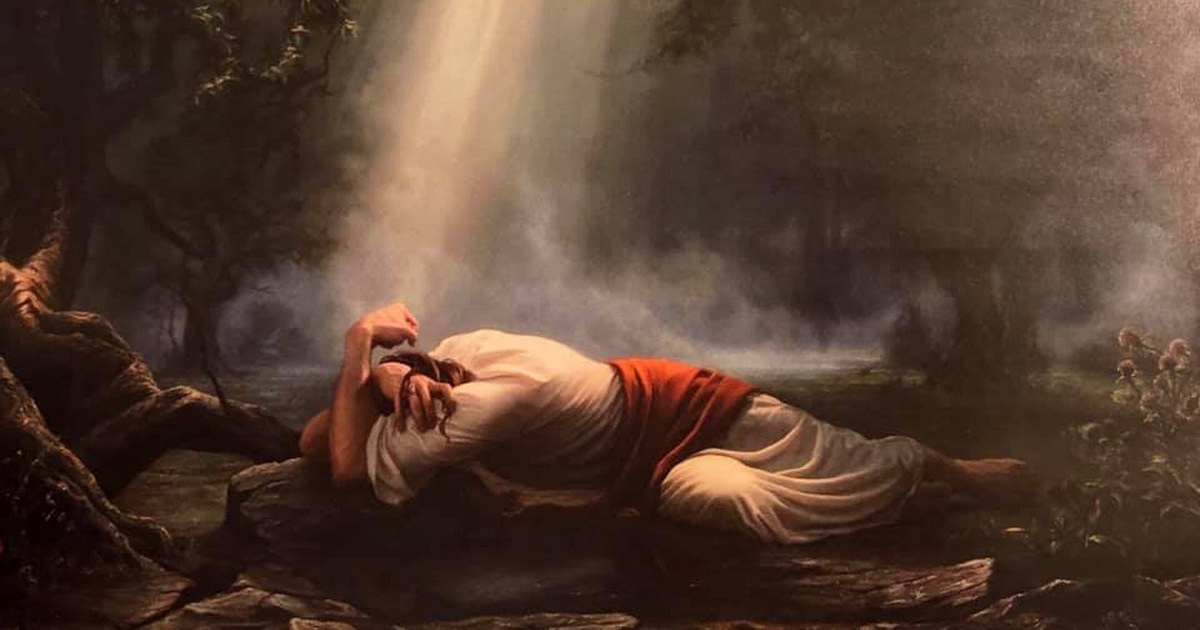
After the supper, after the teaching, after the new commandment — "That ye love one another; as I have loved you" (John 13:34) — Jesus led them out. They sang a hymn. They walked to the Mount of Olives. And then He entered Gethsemane.
Mark records that He "began to be sore amazed, and to be very heavy" (Mark 14:33). The Greek words Mark chose are extraordinary. "Sore amazed" — ekthambeomai — means to be struck with astonishment, even terror. "Very heavy" — ademonein — means to be in anguish so deep it borders on collapse. This was not serene resignation. This was the Son of God staggering under a weight He had not yet fully felt.
He fell on the ground. He cried out, "Abba, Father, all things are possible unto thee; take away this cup from me: nevertheless not what I will, but what thou wilt" (Mark 14:36). Abba — the intimate, familial name. A child's word for a father.
Luke adds the detail the other Gospels omit: "And being in an agony he prayed more earnestly: and his sweat was as it were great drops of blood falling down to the ground" (Luke 22:44). King Benjamin had prophesied this centuries earlier: "blood cometh from every pore, so great shall be his anguish for the wickedness and the abominations of his people" (Mosiah 3:7). And the Lord Himself described it in modern revelation: "Which suffering caused myself, even God, the greatest of all, to tremble because of pain, and to bleed at every pore, and to suffer both body and spirit — and would that I might not drink the bitter cup, and shrink" (D&C 19:18).
The greatest of all — trembling. The body itself breaking open. The final descent.
But here is where we must slow down, because the scope of what happened in that garden is almost incomprehensible. We speak of the Atonement as "infinite," and we should. But we must not let that word become a theological abstraction that floats safely above our own lives. The Atonement is infinite precisely because it is intimate. It reaches every soul who has ever drawn breath — and it reaches each one personally.
Consider the reach of what He bore. Jacob taught that Christ "suffereth the pains of all men, yea, the pains of every living creature, both men, women, and children, who belong to the family of Adam" (2 Nephi 9:21). All who belong to the family of Adam. That is not a sampling. It is everyone who ever lived before that night in Gethsemane — Adam and Eve in their exile, Abraham on the mountain with his son, Hannah weeping for a child, David broken by his own sin, the unnamed millions who suffered and died in obscurity across millennia. It is everyone alive at that moment — the sleeping disciples, the scheming Sanhedrin, the Roman soldiers who did not yet know they would drive nails into His hands. And it is everyone who would ever live after — every generation not yet born, every person who would draw their first breath a hundred years later, a thousand years later, in our day and beyond. The suffering He bore was not limited to the past or present. It reached forward through every century that would follow, encompassing every soul who would ever walk the earth.
And the Lord Himself confirmed this: "For, behold, the Lord your Redeemer suffered death in the flesh; wherefore he suffered the pain of all men, that all men might repent and come unto him" (D&C 18:10–11). The verse just before tells us why: "Remember the worth of souls is great in the sight of God." Not the worth of humanity in the aggregate. The worth of souls — individual, irreplaceable, known.
This is where the Atonement shatters every casual understanding we bring to it. We sometimes picture Gethsemane as a place where a great mass of sin was heaped upon the Savior — something enormous but impersonal, like an ocean of undifferentiated suffering. Elder Merrill J. Bateman, in his October 2005 general conference address, described how his own understanding changed: "For many years I thought of the Savior's experience in the garden and on the cross as places where a large mass of sin was heaped upon Him. Through the words of Alma, Abinadi, Isaiah, and other prophets, however, my view has changed. Instead of an impersonal mass of sin, there was a long line of people, as Jesus felt 'our infirmities,' '[bore] our griefs, … carried our sorrows … [and] was bruised for our iniquities.' The Atonement was an intimate, personal experience in which Jesus came to know how to help each of us."
Each of us. Not humanity as a concept. You. The teenager who cries herself to sleep in shame. The father who cannot shake the addiction that is destroying his family. The widow sitting in an empty house on a Sunday afternoon. The missionary who wonders if God has forgotten him. The woman who was abused and has never told anyone. He did not suffer for a category. He suffered for a person — and then another person, and another, and another, across every generation that has been or will ever be.
Alma understood this dimension of the Atonement with piercing clarity: "He shall go forth, suffering pains and afflictions and temptations of every kind; and this that the word might be fulfilled which saith he will take upon him the pains and the sicknesses of his people. And he will take upon him death, that he may loose the bands of death which bind his people; and he will take upon him their infirmities, that his bowels may be filled with mercy, according to the flesh, that he may know according to the flesh how to succor his people according to their infirmities" (Alma 7:11–12). Notice the purpose: not merely to pay a debt, but to know. To know according to the flesh. To understand what your specific grief feels like from the inside so that He can run to you — the word succor literally means to run to — when you need Him.
Elder Bateman called the Atonement "intimate as well as infinite — infinite in that it spans the eternities, intimate in that the Savior felt each person's pains, sufferings, and sicknesses." And Elder M. Russell Ballard, in his April 2004 general conference address, put it with breathtaking simplicity: "The irony of the Atonement is that it is infinite and eternal, yet it is applied individually, one person at a time."
One person at a time. When the resurrected Christ appeared to the Nephites, He did not bless the crowd. He took their children "one by one, and blessed them, and prayed unto the Father for them" (3 Nephi 17:21). That is who He is. That is how He loves. And that is how He suffered — not for a faceless mass, but for every single face. Yours. Mine. The face of a person who won't be born for another two hundred years. He saw them all, and He stayed.
The Arc of the Night
Step back and trace the evening as a single movement:
He laid aside His garments and took a towel — descending from Master to slave. He washed the feet of men who were arguing about greatness — descending below their pride. He took bread and said, "This is my body" — descending from the one served to the one consumed. He gave the new commandment to love — descending from His own needs to theirs. He entered Gethsemane and fell to the ground — descending below all things. He bled from every pore — the body itself breaking open under the weight of every soul who has ever lived or ever will.
Every act was a step lower. Every moment took Him further down. Paul described the full arc in a single breathtaking passage: He "made himself of no reputation, and took upon him the form of a servant, and was made in the likeness of men: And being found in fashion as a man, he humbled himself, and became obedient unto death, even the death of the cross" (Philippians 2:7–8). And the Doctrine and Covenants gives us the summary that frames the whole night: "He that ascended up on high, as also he descended below all things, in that he comprehended all things" (D&C 88:6).
Thursday night is the answer to every question the disciples ever asked about greatness. They kept asking, "Who is the greatest?" And Thursday night, Jesus stopped answering with words. He answered with His body. He went lower, and lower, and lower, until there was nowhere left to descend.
What Thursday Asks of Us
We live in a world that tells us to climb. Climb the ladder. Build the platform. Accumulate the followers, the titles, the recognition. Even in the Church — and I say this gently, because I have felt it in myself — we can measure our discipleship by our visibility. The calling. The position. The influence.
Thursday night dismantles all of that. Not with a rebuke, but with a basin of water and a broken loaf.
Where in our lives are we still arguing about greatness while Jesus is kneeling at our feet? Where are we calculating our rank while He is handing us the bread of His body? What would it look like to stop climbing and start descending — to take the lower seat, the unseen task, the service that no one applauds?
And perhaps the most pressing question of all: Do we understand that what He did in Gethsemane, He did for us — not for a theological principle, not for a nameless crowd, but for the specific person reading these words right now? He knows your name. He has felt your exact sorrow. He did not suffer in generalities. He suffered in specifics — your specifics — so that when you reach for Him, He would know precisely how to reach back.
President Howard W. Hunter taught that "true greatness" comes not from worldly achievement but from "the thousands of little deeds and tasks of service and sacrifice that constitute the giving, or losing, of one's life for others and for the Lord." He was describing the theology of Thursday night without naming it. The greatest in the kingdom is the one who serves. And the greatest who ever lived proved it by kneeling on a stone floor with a towel around His waist, washing the feet of men who were arguing about who deserved to sit closest to Him.
Tomorrow — Friday — the descent will continue. The trials. The scourging. The cross. But Thursday is where it began. Thursday is where the King of Heaven chose to go lower than anyone had ever gone, and kept going, and kept going, until the scripture could say of Him what it can say of no one else: "The Son of Man hath descended below them all" (D&C 122:8).
They asked who was the greatest. He answered by becoming the least. And the least of all became the Savior of all — not of all in the abstract, but of each, one by one, forever.
Art Credit: Carl Heinrich Bloch, "Christ in Gethsemane" (c.1880). Public domain.