They killed Him on a Friday. That fact needs to be said plainly, because the theology of what happened can sometimes float above the raw, physical horror of what was done to a human body on a hill outside Jerusalem.
After the scourging, after the mockery, after the crown of thorns was pressed into His scalp and a purple robe was draped over His shredded back, they led Him out to a place called Golgotha — the place of a skull. John says He went "bearing his cross" (John 19:17–18). When they arrived, they crucified Him — and two others with Him, one on either side, Jesus in the middle. Matthew records the detail with devastating understatement: "And they crucified him, and parted his garments, casting lots" (Matthew 27:35). While He hung dying, the soldiers were dividing up His clothes like men splitting a dinner check. Above His head, Pilate had ordered a sign nailed to the wood: "Jesus of Nazareth the King of the Jews" (John 19:19) — written in Hebrew, Greek, and Latin so that no one passing by could miss the mockery.
He hung there for six hours. From about nine in the morning until three in the afternoon. At noon, darkness covered the land and did not lift for three hours (Luke 23:44). Somewhere in that darkness He cried out, "My God, my God, why hast thou forsaken me?" (Matthew 27:46). And then, near the end: "Father, into thy hands I commend my spirit" (Luke 23:46). And He gave up the ghost.
The earth shook. The veil of the temple tore from top to bottom. A Roman centurion — a pagan soldier with no stake in Jewish theology — looked at the dead man on the cross and said, "Truly this man was the Son of God" (Mark 15:39).
Half a world away, the destruction was even more violent. The Book of Mormon records that tempests, earthquakes, and fires ravaged the land for three hours — cities sinking, mountains collapsing, the whole face of the earth deformed — and then a thick darkness settled that lasted three days. "There was great mourning and howling and weeping among all the people continually; yea, great were the groanings of the people, because of the darkness and the great destruction which had come upon them" (3 Nephi 8:23). Creation itself convulsed at the death of its Creator.
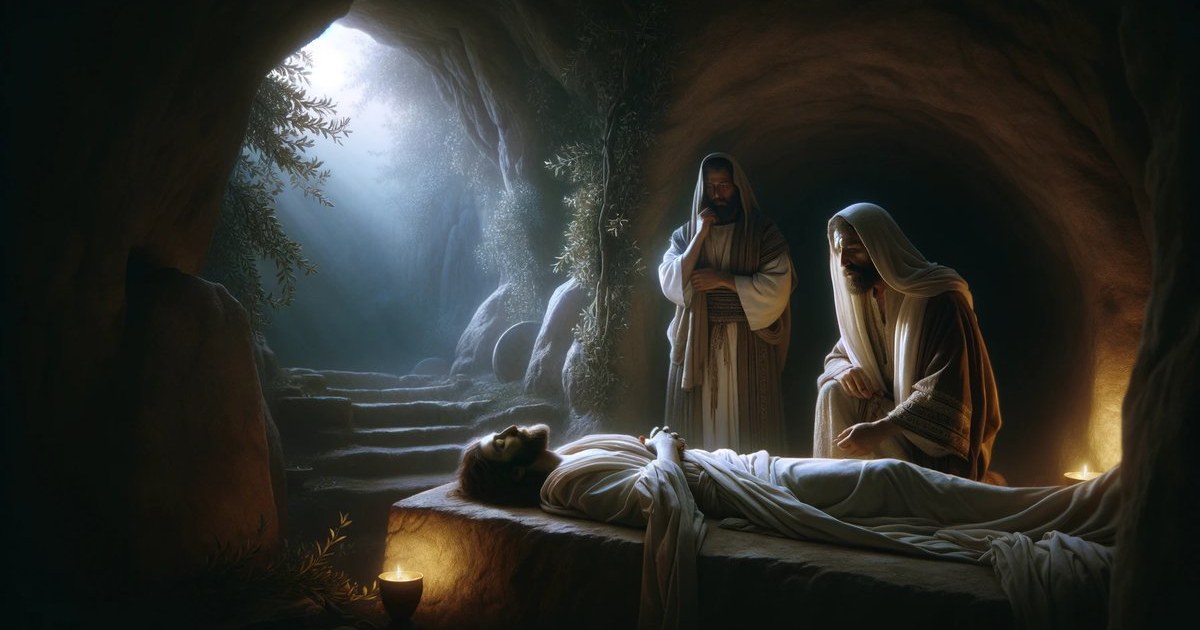
Then came the quiet acts of tenderness that follow death in every age. Joseph of Arimathea — a wealthy member of the Sanhedrin who had been a disciple of Jesus "but secretly for fear of the Jews" (John 19:38) — went boldly to Pilate and asked for the body. Nicodemus came too, the same man who had once come to Jesus by night, and he brought a hundred pounds of myrrh and aloes (John 19:39). Together they wrapped the body in clean linen with the spices and laid it in a new tomb hewn from rock. Joseph rolled a great stone to the door of the sepulchre and departed (Matthew 27:59–60). Mary Magdalene and the other Mary sat across from the tomb and watched (Matthew 27:61). Luke adds that the women from Galilee followed, saw how His body was laid, and then "returned, and prepared spices and ointments; and rested the sabbath day according to the commandment" (Luke 23:55–56).
Two men who had hidden their faith came forward only after it was too late. Women who had followed Him from Galilee sat vigil at a grave. And then the Sabbath began, and everyone stopped. Because the law required it. Because there was nothing left to do.
The stone was in place. The seal was set. The guards took their positions. And the longest day in the history of the world began — not with a bang, but with nothing. Silence. Absence. A body in a borrowed tomb and a universe holding its breath.
The Day Nobody Talks About
Saturday is the day the Gospels barely mention. Matthew records that the chief priests and Pharisees went to Pilate to request a guard for the tomb, "lest his disciples come by night, and steal him away" (Matthew 27:62–66). That is nearly all the New Testament gives us for the entire day. Mark is silent. Luke is silent. John is silent.
For the disciples, Saturday must have been unbearable — not because something terrible was happening, but because nothing was happening at all. The horror of Friday was over. The miracle of Sunday had not yet come. They were suspended between the worst thing they had ever witnessed and a hope they did not yet have any reason to feel.
We know that place. Most of us live there more often than we live at Golgotha or the empty tomb.
Holy Week sermons tend to leap from Friday to Sunday. From the cross to the empty tomb. From "It is finished" to "He is risen." And understandably so — those are the hinge points of eternity. But the leap skips Saturday, and Saturday is where most of mortality actually takes place.
Saturday is the day between the promise and the proof. It is the missionary who has been out for fourteen months and has not yet seen a baptism. It is the couple who received a priesthood blessing promising healing and are still sitting in the oncologist's waiting room. It is the parent who has done everything they know how to do and whose child still will not come home. It is the prayer that went up last night — earnest, broken, real — and the ceiling that still feels like concrete this morning.
Friday, for all its horror, at least has the terrible momentum of event. Things are happening. You can see them, fight them, weep over them. And Sunday has the explosion of joy, the vindication of every hope. But Saturday? Saturday is the silence of God. And silence, for people of faith, can be harder to endure than suffering.
Elder Neal A. Maxwell, who understood waiting as well as anyone who ever held apostolic office, said it with characteristic precision: "Real hope is much more than wishful musing. It stiffens, not slackens, the spiritual spine" ("Hope through the Atonement of Jesus Christ," October 1998 General Conference). Saturday is where the spine is tested.
But He Was Not Idle
Here is what the disciples did not know on that long Saturday, what they could not have known: Jesus was not resting. The body in the tomb was still. But the Christ who had descended below all things on Thursday night and Friday afternoon had not stopped descending. He had gone further — into the realm of the dead, where billions of God's children waited.
Peter would later write the briefest account of it: "For Christ also hath once suffered for sins, the just for the unjust, that he might bring us to God, being put to death in the flesh, but quickened by the Spirit: By which also he went and preached unto the spirits in prison" (1 Peter 3:18–19). And again: "For for this cause was the gospel preached also to them that are dead, that they might be judged according to men in the flesh, but live according to God in the spirit" (1 Peter 4:6).
For nearly two thousand years, those verses were all Christianity had. A hint. A shadow. Enough to know that something happened between the cross and the garden tomb, but not enough to know what.
Then came October 3, 1918. President Joseph F. Smith — eighty years old, gravely ill, having buried his son Hyrum Mack Smith just months earlier, having lost twelve children in his lifetime — sat in his room pondering those very verses in 1 Peter. And the eyes of his understanding were opened.
What he saw became Doctrine and Covenants 138 — one of only two twentieth-century revelations canonized as scripture. And it fills in Saturday with a scene so vast, so tender, so deliberate that it changes everything about what the silence meant.
What the Silence Held
President Smith saw them first — "an innumerable company of the spirits of the just, who had been faithful in the testimony of Jesus while they lived in mortality" (D&C 138:12). They were gathered together, "filled with joy and gladness, and were rejoicing together because the day of their deliverance was at hand" (D&C 138:15).
Think about who was in that assembly. Adam and Eve. Abel. Noah. Abraham and Sarah. Isaiah. Ezekiel. Daniel. Nephite prophets who had testified of the coming of the Son of God. They had all died in faith, "firm in the hope of a glorious resurrection" (D&C 138:14). Some had waited centuries. Some had waited millennia. And they had "looked upon the long absence of their spirits from their bodies as a bondage" (D&C 138:50).
That word — bondage — should stop us. These were righteous spirits. They were in paradise, in what Alma described as "a state of happiness … a state of rest, a state of peace, where they shall rest from all their troubles and from all care, and sorrow" (Alma 40:12). And yet even paradise, without the body, felt like bondage. Even rest, without resurrection, felt incomplete. They were waiting for something only Christ could bring.
And then He came.
"While this vast multitude waited and conversed, rejoicing in the hour of their deliverance from the chains of death, the Son of God appeared, declaring liberty to the captives who had been faithful; And there he preached to them the everlasting gospel, the doctrine of the resurrection and the redemption of mankind from the fall, and from individual sins on conditions of repentance" (D&C 138:18–19).
Their countenances shone. The radiance from the presence of the Lord rested upon them. And they sang praises unto His holy name.
That was Saturday. While the disciples huddled in Jerusalem, paralyzed by grief, and the Pharisees congratulated themselves on a problem solved, Jesus was standing before the assembled righteous dead, declaring liberty. The silence above ground was covering the most magnificent rescue operation in history.
He Organized His Forces
President Smith marveled at the scope of the work — how could the Savior have preached to so many in so short a time? And then the revelation clarified something remarkable: Jesus did not go personally to the wicked and the disobedient. Instead, "from among the righteous, he organized his forces and appointed messengers, clothed with power and authority, and commissioned them to go forth and carry the light of the gospel to them that were in darkness, even to all the spirits of men; and thus was the gospel preached to the dead" (D&C 138:30).
Read that again slowly. On Saturday — the silent day, the nothing day, the day the world thought it was all over — Jesus was organizing a missionary force. He was commissioning the righteous dead to carry the gospel to every soul who had never heard it. He was building the infrastructure of salvation for the dead, the theological foundation on which every temple ever built would rest.
The world saw a sealed tomb. God saw the launch of the largest missionary effort in the history of eternity.
Elder Spencer J. Condie captured the Latter-day Saint distinction perfectly: "The facts of Jesus' death and Resurrection are hailed by those of Christian denominations as fundamental tenets. However, what Jesus' immortal spirit did after His death and before His Resurrection is a mystery to all but the Latter-day Saints. And the significance of what He did during those hours provides the doctrinal foundation for building temples across the earth" ("The Savior's Visit to the Spirit World," Ensign, July 2003).
The Saturday We Are Living
There is a reason this matters beyond historical interest. We are all living a version of Saturday right now.
We live after the Atonement and the Resurrection — those are settled facts of our faith. But we live before the Second Coming. We live in the long middle, the stretch of silence between the definitive act of redemption and its final, visible consummation. We live in the time when the tomb appears sealed, when the world declares God dead or irrelevant, when the evidence for hope must be carried in the heart because it is not yet visible to the eye.
And this is where Elder Holland's words from his October 2020 general conference address reach us with particular force. Speaking of waiting on the Lord, he said: "Faith means trusting God in good times and bad, even if that includes some suffering until we see His arm revealed in our behalf." And then, with an honesty that only someone who had himself waited could muster: "Our harvest, Alma says, comes 'by and by.' And whether that be a short period or a long one is not always ours to say, but by the grace of God, the blessings will come to those who hold fast to the gospel of Jesus Christ."
By and by. That is Saturday's theology. Not never. Not right now. By and by.
The disciples on that first Saturday did not know Sunday was coming. They could not see it. They had been told — Jesus had said it plainly, more than once — but the grief was too thick and the tomb was too real and the silence was too heavy. They had only the memory of what He had said and the ache of what they had lost.
We have more than they did. We have the testimony of the empty tomb. We have the witness of the Nephite multitude who felt the prints in His hands. We have a Restoration that began with a pillar of light and has not stopped unfolding. We have temples on every continent where the work Jesus began on Saturday continues every single day — the righteous, clothed with power and authority, carrying the light of the gospel to those who wait in darkness.
And we have the promise He made, which has never been revoked: "I will not leave you comfortless: I will come to you" (John 14:18).
What Saturday Teaches
Saturday teaches that God is not absent when He is silent. The most consequential work of Holy Week — apart from Gethsemane and Calvary themselves — happened on the day the Gospels say almost nothing about. The rescue of the dead, the organization of the spirit world, the commissioning of an eternal missionary force — all of it took place behind a sealed stone, out of sight, in the quiet.
If that is how God works on the cosmic scale, why would we expect Him to work differently in our lives?
The promotion that hasn't come. The diagnosis that hasn't changed. The child who hasn't called. The loneliness that hasn't lifted. The prayer that seems to have gone nowhere. These are not evidence of God's absence. They may be evidence of His deepest work — the kind that happens out of sight, behind the stone, in the place you cannot yet see.
Saturday is the day that asks us to believe without seeing. To trust that behind the sealed tomb, liberty is being declared. To hold on — not because the evidence is in, but because the One who said "I have overcome the world" has never once been wrong.
Tomorrow the stone will move. Tomorrow Mary will hear her name spoken in a voice she thought she would never hear again. Tomorrow the world will change forever. But that is tomorrow's story.
Today is Saturday. And on Saturday, we wait. Not passively, not hopelessly, but the way the righteous dead waited — "filled with joy and gladness … because the day of their deliverance was at hand." They could not see the Resurrection yet. But they knew the One who had promised it. And when He appeared among them, they were not surprised. They were ready.
May we be ready too. Sunday is coming.