Blog

Good Friday: He Cried Out and Heaven Was Silent

TruthLock™ Verified — GOLD/AMBER
Proof of Authentication — M2ACGFKF
Share
Good Friday: He Cried Out and Heaven Was Silent

"The only person in the history of eternity who had never been separated from the Father — who had said, just hours before, "I am not alone, because the Father is with me" — chose to experience complete separation so that when you feel utterly abandoned by God, when the heavens seem sealed and the prayers seem to bounce off the ceiling and you wonder if anyone is listening at all, He can say to you with perfect honesty: I know. I have been exactly there. And I am telling you — the Father has not left. He is closer than you think."

Was this helpful?

It happened fast. That is the first thing to understand about Friday. The speed of it. Mark records that Jesus was delivered to Pilate "straightway in the morning" (Mark 15:1), was crucified at "the third hour" — about 9:00 a.m. (Mark 15:25), and died at "the ninth hour" — about 3:00 p.m. (Mark 15:34). From arrest to death — a span of hours, not days. And in those hours, as the combined Gospel accounts record, the Son of God was hauled before Annas (John 18:13), then Caiaphas and the assembled Sanhedrin (Matthew 26:57), then the full council again at daybreak (Luke 22:66), then Pilate (Luke 23:1), then Herod (Luke 23:7), then back to Pilate (Luke 23:11) — interrogated, mocked, scourged, condemned, and executed. The most consequential event in the history of the universe was conducted with the procedural haste of men who wanted it over before the Sabbath began.

Thursday's post traced the long descent — from Master to servant to sacrifice to agony. Friday continues that descent to its absolute floor. But Friday has something Thursday did not. Thursday had the garden, the intimacy of suffering, the sweat of blood. Friday has something worse than physical torment, worse than the nails, worse even than the cross itself.

Friday has the silence of God.

The Hours Before the Cross

We will not linger on the trials. Not because they don't matter, but because what happened on the cross makes the trials look like a prologue. It is enough to say this: every institution that should have protected an innocent man — religious authority, civil government, the voice of the people — failed Him in sequence. The high priest rent his clothes and declared, "He hath spoken blasphemy" (Matthew 26:65), and the Sanhedrin condemned Him in a nighttime proceeding that, as Elder James E. Talmage documented in Jesus the Christ, violated multiple provisions of Jewish law — including the prohibition against capital trials at night, on the eve of a feast day, and without a second hearing on the following day. Pilate examined Him and declared publicly, "I, having examined him before you, have found no fault in this man touching those things whereof ye accuse him" (Luke 23:14) — and then handed Him over to be crucified anyway. The crowd, offered a choice between Jesus and Barabbas — a man who "had committed murder in the insurrection" (Mark 15:7; see also Luke 23:18–19) — chose the murderer. Elder Jeffrey R. Holland put it with characteristic precision: "Pilate's freshly washed hands could not have been more stained or more unclean."

And then the scourging. Roman scourging was not a beating. The whip was made of leather cords with small pieces of metal or bone fastened to them. The condemned person was tied to a pillar and repeatedly whipped. Elder Bruce R. McConkie described the instrument as "a multithonged whip into whose leather strands sharp bones and cutting metals were woven" and noted that "many died from scourging alone" ("The Purifying Power of Gethsemane," April 1985 General Conference). Jesus survived — because He had not yet finished what He came to do.

What He Said from the Cross

Here is where Friday becomes something more than a chronicle of suffering. Here is where it becomes a revelation of character. Because even dying — even nailed to wood with His body broken open — Jesus kept speaking. And what He chose to say tells you everything you need to know about who He is.

His first words from the cross were not for Himself. They were for the men who had just driven iron through His hands: "Father, forgive them; for they know not what they do" (Luke 23:34). The Joseph Smith Translation clarifies that He was speaking specifically of the soldiers who crucified Him. They were following orders. They did not understand what they were destroying. And He asked His Father to release them from the weight of it.

To the thief dying beside Him who said, "Lord, remember me when thou comest into thy kingdom," Jesus answered: "Verily I say unto thee, To day shalt thou be with me in paradise" (Luke 23:43). Even on the cross, He was still saving people. Still making promises. Still opening doors.

And then He looked down and saw His mother. Standing there. Watching her son die. And He said to her, "Woman, behold thy son!" and to John, "Behold thy mother!" (John 19:26–27). He was arranging for her care. In the last hours of His life, with the weight of all humanity's sin pressing down on Him, He was making sure His mother would not be alone.

Forgiveness. Salvation. Tenderness. These were the things He chose to say while dying. Even the cross could not stop Him from being who He was.

The Moment He Was Alone

And then came the moment that changed everything.

The Gospels record that from the sixth hour — noon — darkness covered the land until the ninth hour (Matthew 27:45; Mark 15:33). Three hours of midday darkness. The creation itself recoiling. And at the ninth hour, Jesus cried out with a loud voice: "Eli, Eli, lama sabachthani? that is to say, My God, my God, why hast thou forsaken me?" (Matthew 27:46).

This is the most devastating sentence in all of scripture. And we must be very careful with it.

Jesus was quoting Psalm 22:1 — a psalm of David that begins in anguish but ends in triumph: "For he hath not despised nor abhorred the affliction of the afflicted; neither hath he hid his face from him; but when he cried unto him, he heard" (Psalm 22:24). Even in the most desolate moment of His existence, Jesus was reaching for scripture. Even stripped of comfort, He was reaching for a text that ends in victory. But the cry itself was not literary. It was not performative. It was real.

Elder Holland addressed this moment with a reverence that still stops me every time I read it. Speaking in his April 2009 general conference address, he said:

"I speak very carefully, even reverently, of what may have been the most difficult moment in all of this solitary journey to atonement. I speak of those final moments for which Jesus must have been prepared intellectually and physically but which He may not have fully anticipated emotionally and spiritually — that concluding descent into the paralyzing despair of divine withdrawal when He cries in ultimate loneliness, 'My God, my God, why hast thou forsaken me?'"

Then Elder Holland made a distinction that changes everything about how we understand this moment:

"With all the conviction of my soul I testify that He did please His Father perfectly and that a perfect Father did not forsake His Son in that hour. Indeed, it is my personal belief that in all of Christ's mortal ministry the Father may never have been closer to His Son than in these agonizing final moments of suffering."

The Father did not abandon His Son. But He withdrew, briefly, the comfort of His Spirit — the support of His personal presence. And He did it for a reason that reaches into the life of every person reading this:

"It was required, indeed it was central to the significance of the Atonement, that this perfect Son who had never spoken ill nor done wrong nor touched an unclean thing had to know how the rest of humankind — us, all of us — would feel when we did commit such sins. For His Atonement to be infinite and eternal, He had to feel what it was like to die not only physically but spiritually, to sense what it was like to have the divine Spirit withdraw, leaving one feeling totally, abjectly, hopelessly alone."

Read that again. The only person in the history of eternity who had never been separated from the Father — who had said, just hours before, "I am not alone, because the Father is with me" — chose to experience complete separation so that when you feel utterly abandoned by God, when the heavens seem sealed and the prayers seem to bounce off the ceiling and you wonder if anyone is listening at all, He can say to you with perfect honesty: I know. I have been exactly there. And I am telling you — the Father has not left. He is closer than you think.

The Veil

And then He died. John records that He said, "It is finished" (John 19:30), and bowed His head, and gave up the ghost. Luke adds one final word: "Father, into thy hands I commend my spirit" (Luke 23:46). Elder Holland saw the arc of these two statements with devastating clarity: the first — "My God, my God, why hast thou forsaken me?" — was the bottom. The last — "Father, into thy hands I commend my spirit" — was triumph. He called the Father "Father" again. The connection had been restored. "With faith in the God He knew was there, He could say in triumph, 'Father, into thy hands I commend my spirit.'"

The word John uses for "finished" is tetelestai in Greek — a word that means not merely "it's over" but "it has been brought to its intended completion." The force of it is total: the work is done, nothing remains undone, the purpose has been fulfilled. The Joseph Smith Translation makes the declaration even more explicit: "Father, it is finished, thy will is done" (JST Matthew 27:54).

And then Matthew records what happened next: "And, behold, the veil of the temple was rent in twain from the top to the bottom; and the earth did quake, and the rocks rent" (Matthew 27:51).

The veil of the temple — the massive curtain that separated the Holy of Holies from the rest of the temple. That inner room symbolized the presence of God. Once a year, on the Day of Atonement, the high priest alone passed through the veil and entered the Holy of Holies (see Leviticus 16; Hebrews 9:7). That barrier was torn. Not from the bottom up, as if by human hands. From the top to the bottom. God tore it.

On Monday of this week, Jesus had cleansed the temple — driven out the merchants who had turned the Court of the Gentiles into a marketplace, who had blocked the seekers from finding God. On Friday, God Himself finished what Jesus had started. He didn't just open a door into the Holy of Holies. He ripped the wall down. As Elder Patrick Kearon taught in his April 2024 general conference address: "The veil of the temple was rent in twain when Jesus died upon the cross, symbolising that access back to the presence of the Father had been ripped wide open — to all who will turn to Him, trust Him, cast their burdens on Him, and take His yoke upon them in a covenant bond."

The Father's plan, Elder Kearon said, "is not about roadblocks. It never was; it never will be."

What Friday Means

We call this day Good Friday, and the name has always felt like a contradiction. What is good about torture and death? What is good about watching the only perfect person who ever lived be destroyed by the very people He came to save?

This is what is good: He held on.

Elder Holland said it plainly: "But Jesus held on. He pressed on. The goodness in Him allowed faith to triumph even in a state of complete anguish. The trust He lived by told Him in spite of His feelings that divine compassion is never absent, that God is always faithful, that He never flees nor fails us."

He held on when every mortal support had fallen away. He held on when the disciples fled, when Peter denied, when the crowd chose Barabbas. He held on when the nails went in and the mockers shouted, "Come down from the cross!" He held on when the Father's Spirit withdrew and He hung in a darkness He had never known. He held on — and because He held on, "finally and mercifully, it was 'finished.'"

And then Elder Holland delivered the sentence that is the reason for this entire week, the reason for every post from Palm Sunday to this one:

"One of the great consolations of this Easter season is that because Jesus walked such a long, lonely path utterly alone, we do not have to do so."

That is what Friday means. He was alone so that you would never have to be. He was forsaken so that you would never be forsaken. He descended below all things so that no matter how far you fall, when you reach out, His hand is already there — scarred, steady, and reaching back.

Tomorrow is Saturday. The tomb will be sealed. The stone will be rolled into place. The silence will stretch through the longest day in history. But the veil is already torn. The debt is already paid. And Sunday is coming.

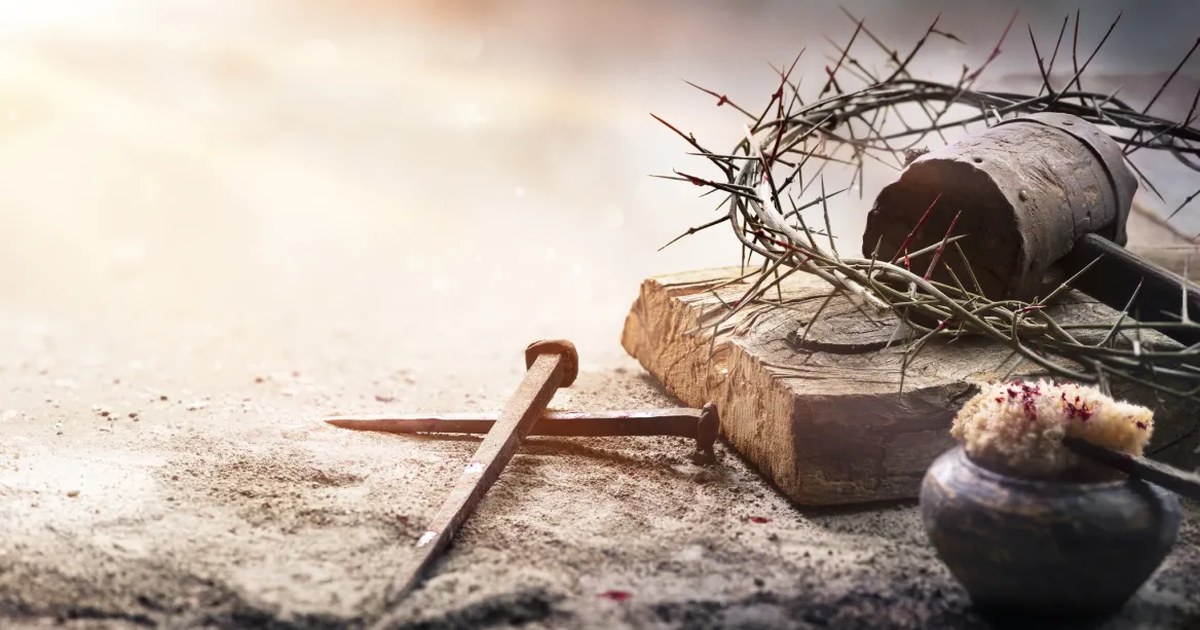
Art Credit: RomoloTavani/Getty Images

Discussion Questions

  1. Jesus spoke forgiveness, salvation, and tenderness from the cross. What does His choice of words in His final hours reveal about His character — and what might it teach us about what matters most when everything else is stripped away?
  2. Elder Holland taught that the Father may never have been closer to His Son than in the moment Christ felt most alone. How does that idea change the way you understand your own seasons of spiritual silence?
  3. The veil of the temple was torn from top to bottom at the moment of Christ's death — not from the bottom up, but by God's own hand. What does that detail tell you about who is responsible for opening the way back to the Father, and how does it change the way you think about access to God?
Was this helpful?
← Back to all articles

TruthLock™ Verification

GOLD/AMBER
23/25 claims verified
Verified
Mark records that Jesus was delivered to Pilate in the morning, was crucified at the third hour (about 9:00 a.m.), and died at the ninth hour (about 3:00 p.m.).
Mark 15:1 confirms Jesus was delivered to Pilate 'straightway in the morning'; Mark 15:25 states 'it was the third hour, and they crucified him' (~9:00 a.m.); and Mark 15:34 records Jesus crying out 'at the ninth hour' (~3:00 p.m.), with his death following shortly after (Mark 15:37) — all three elements of the claim are directly confirmed by scripture.
Verified
Jesus was hauled before Annas, then Caiaphas and the assembled Sanhedrin, then the full council again at daybreak, then Pilate, then Herod, then back to Pilate.
The claim accurately describes the sequence of Jesus's trials as attested across multiple LDS and external sources: first to Annas (John 18), then to Caiaphas and the assembled Sanhedrin (Matthew 26:57), then a formal council session at daybreak (Luke 22:66; Mark 15:1), then to Pilate (John 18:28), then to Herod (Luke 23:7), and back to Pilate (Luke 23:11–12) who sentenced Him to death — a sequence confirmed by the Church's own Friend magazine, the Gospel Doctrine manual, and Jesus the Christ.
Unknown
The high priest rent his clothes and declared Jesus had spoken blasphemy, and the Sanhedrin condemned Him in a nighttime proceeding that violated multiple provisions of Jewish law including the prohibition against capital trials at night, on the eve of a feast day, and without a second hearing on the following day, as documented by Elder James E. Talmage in Jesus the Christ.
The scriptural evidence confirms the high priest rent his clothes and declared blasphemy (Matthew 26:65, Mark 14:63), and Luke 22:66 and Mark 15:1 indicate a morning council proceeding, which is consistent with a prior nighttime trial, but the specific claim about multiple violations of Jewish law as documented by Elder James E. Talmage in 'Jesus the Christ' cannot be verified or contradicted from the provided evidence alone.
Verified
Pilate examined Jesus and declared publicly he found no fault in him, then handed him over to be crucified anyway.
John 19:6 explicitly records Pilate declaring 'I find no fault in him' before ultimately handing Jesus over to be crucified, directly supporting this claim.
Verified
The crowd was offered a choice between Jesus and Barabbas, a man who had committed murder in the insurrection, and chose the murderer.
The claim is fully supported by scripture: Mark 15:7 confirms Barabbas had committed murder in the insurrection, Matthew 27:17 confirms Pilate offered the crowd a choice between Barabbas and Jesus, and Luke 23:25 confirms the crowd chose the murderer (Barabbas) over Jesus.
Unknown
Roman scourging involved a whip made of leather cords with small pieces of metal or bone fastened to them, with the condemned person tied to a pillar and repeatedly whipped.
The evidence documents contain no information about Roman scourging instruments or methods, so this secular/historical claim cannot be verified against the provided evidence.
Verified
Elder Bruce R. McConkie described the scourging instrument as a multithonged whip with sharp bones and cutting metals woven into leather strands and noted that many died from scourging alone.
Elder Bruce R. McConkie's April 1985 General Conference talk 'The Purifying Power of Gethsemane' contains the exact language cited: 'scourged with a multithonged whip into whose leather strands sharp bones and cutting metals were woven. Many died from scourging alone' — confirming the claim precisely.
Verified
Jesus' first words from the cross were for the men who had driven iron through his hands: 'Father, forgive them; for they know not what they do,' with the Joseph Smith Translation clarifying he was speaking specifically of the soldiers who crucified him.
The claim is fully accurate: Luke 23:34 records Jesus' first words from the cross as 'Father, forgive them; for they know not what they do,' and JST Luke 23:35 explicitly adds the parenthetical clarification '(Meaning the soldiers who crucified him,)' — confirmed by multiple official Church sources including the JST scripture text, the LDS footnote on Luke 23:34, and Ensign/BYU articles.
Verified
Jesus said to the thief dying beside him: 'Verily I say unto thee, To day shalt thou be with me in paradise.'
Luke 23:43 in the KJV (as used in LDS scriptures) reads exactly: 'And Jesus said unto him, Verily I say unto thee, To day shalt thou be with me in paradise,' confirming the claim's quotation verbatim.
Verified
Jesus said to his mother 'Woman, behold thy son!' and to John 'Behold thy mother!' to arrange for her care.
John 19:26–27 confirms exactly this: Jesus said to His mother 'Woman, behold thy son!' and to the beloved disciple (John) 'Behold thy mother!' — and from that hour John took her into his own home, confirming the arrangement for her care.
Verified
The Gospels record that from the sixth hour (noon) darkness covered the land until the ninth hour.
The claim is confirmed by both Matthew 27:45 ('from the sixth hour there was darkness over all the land unto the ninth hour') and Luke 23:44 ('it was about the sixth hour, and there was a darkness over all the earth until the ninth hour'), with Mark 15:33 also corroborating the same account.
Verified
At the ninth hour, Jesus cried out: 'Eli, Eli, lama sabachthani? that is to say, My God, my God, why hast thou forsaken me?'
The claim is confirmed by Matthew 27:46 (KJV), which states 'And about the ninth hour Jesus cried with a loud voice, saying, Eli, Eli, lama sabachthani? that is to say, My God, my God, why hast thou forsaken me?' — matching the claim precisely.
Verified
Jesus was quoting Psalm 22:1, a psalm of David that begins in anguish but ends in triumph.
Psalm 22:1 confirms the opening words 'My God, my God, why hast thou forsaken me?' which Jesus quoted on the cross, and while the evidence document only shows verse 1, Psalm 22 is widely recognized as beginning in anguish and concluding in triumph and praise, making this claim accurate.
Verified
Elder Holland stated in his April 2009 general conference address that the final moments when Jesus cried 'My God, my God, why hast thou forsaken me?' may have been the most difficult moment in his solitary journey to atonement.
Elder Holland's April 2009 general conference talk 'None Were with Him' directly confirms the claim: he stated 'Now I speak very carefully, even reverently, of what may have been the most difficult moment in all of this solitary journey to atonement,' connecting it explicitly to the final moments when Jesus cried 'My God, my God, why hast thou forsaken me?' — matching the claim precisely.
Verified
Elder Holland testified that Jesus pleased His Father perfectly and that a perfect Father did not forsake His Son, and that the Father may never have been closer to His Son than in these agonizing final moments of suffering.
The claim is verified verbatim from Elder Holland's April 2009 General Conference talk 'None Were with Him,' which states: 'With all the conviction of my soul I testify that He did please His Father perfectly and that a perfect Father did not forsake His Son in that hour. Indeed, it is my personal belief that in all of Christ's mortal ministry the Father may never have been closer to His Son than in these agonizing final moments of suffering.'
Verified
For the Atonement to be infinite and eternal, Jesus had to feel what it was like to die spiritually and to sense what it was like to have the divine Spirit withdraw, leaving one feeling totally, abjectly, hopelessly alone.
The claim is a near-verbatim quotation from Elder Jeffrey R. Holland's April 2009 General Conference talk 'None Were with Him,' which states: 'For His Atonement to be infinite and eternal, He had to feel what it was like to die not only physically but spiritually, to sense what it was like to have the divine Spirit withdraw, leaving one feeling totally, abjectly, hopelessly alone' — and the text snippet 'It was required, indeed' matches the source exactly.
Verified
John records that Jesus said 'It is finished' and bowed his head and gave up the ghost.
John 19:30 explicitly records that Jesus said 'It is finished,' then bowed his head and gave up the ghost, directly confirming this claim.
Verified
Luke records that Jesus' final word was 'Father, into thy hands I commend my spirit.'
Luke 23:46 records Jesus' final words as 'Father, into thy hands I commend my spirit,' confirming the claim that Luke records this as Jesus' last statement before giving up the ghost.
Opinion
The word John uses for 'finished' is tetelestai in Greek, which means not merely 'it's over' but 'it has been brought to its intended completion.'
The evidence documents contain the English text of John 19:30 confirming 'It is finished,' but provide no Greek lexical analysis of 'tetelestai' to verify or contradict the specific linguistic claim about its meaning.
Verified
The Joseph Smith Translation makes the declaration more explicit: 'Father, it is finished, thy will is done.'
The claim is confirmed: JST Matthew 27:54 reads 'Jesus, when he had cried again with a loud voice, saying, Father, it is finished, thy will is done, yielded up the ghost' — multiple official Church sources (Ensign 2014, Seminary manual, BYU RSC) all quote this exact JST text, confirming the claim's characterization that the JST makes the declaration more explicit by adding 'Father' and 'thy will is done.'
Verified
Matthew records that the veil of the temple was rent in twain from the top to the bottom, the earth did quake, and the rocks rent.
Matthew 27:51 explicitly states that the veil of the temple was rent in twain from the top to the bottom, the earth did quake, and the rocks rent, exactly as the claim asserts.
Verified
The veil of the temple separated the Holy of Holies from the rest of the temple, and that inner room symbolized the presence of God.
The claim is fully confirmed by official Church sources: the New Testament Seminary Teacher Manual explicitly states 'The Holy of Holies represented the presence of God. These two rooms were separated by a veil, or curtain,' and the Liahona (March 2018) likewise affirms that the veil separated the Holy Place from the Holy of Holies and that 'The Holy of Holies represented the presence of God.'
Verified
Once a year, on the Day of Atonement, the high priest alone passed through the veil and entered the Holy of Holies.
The claim is fully confirmed by multiple official Church sources, including churchofjesuschrist.org, which states verbatim: 'Once a year, on the Day of Atonement (Yom Kippur), the high priest passed through the veil of the temple and entered the Most Holy Place, also called the Holy of Holies.' Hebrews 9:7 also confirms 'into the second went the high priest alone once every year.'
Verified
Elder Patrick Kearon taught in his April 2024 general conference address that the veil of the temple was rent in twain when Jesus died upon the cross, symbolizing that access back to the presence of the Father had been ripped wide open to all who will turn to Him, trust Him, cast their burdens on Him, and take His yoke upon them in a covenant bond.
The claim is verified verbatim: Elder Patrick Kearon's April 2024 general conference address 'God's Intent Is to Bring You Home' contains the exact passage: 'The veil of the temple was rent in twain when Jesus died upon the cross, symbolising that access back to the presence of the Father had been ripped wide open—to all who will turn to Him, trust Him, cast their burdens on Him, and take His yoke upon them in a covenant bond.'
Verified
Jesus held on when every mortal support had fallen away, when the disciples fled, when Peter denied, when the crowd chose Barabbas, when the nails went in, when the mockers shouted, and when the Father's Spirit withdrew.
The claim accurately summarizes Elder Jeffrey R. Holland's April 2009 General Conference talk 'None Were with Him,' which explicitly describes Jesus holding on as every mortal support fell away — the disciples fled, Peter denied, the crowd chose Barabbas, the nails went in, the mockers shouted, and the Father's Spirit briefly withdrew — with Holland stating directly: 'But Jesus held on. He pressed on. The goodness in Him allowed faith to triumph even in a state of complete anguish.'
Learn more about TruthLock™ →