Blog

When God Writes on the Stone You Bring

TruthLock™ Verified — GOLD/AMBER
Proof of Authentication — P3P426ZQ
Share
When God Writes on the Stone You Bring

"God's fullest description of Himself on Sinai comes after the failure, not before it."

Was this helpful?

There's a detail in Exodus 34 that most of us read right past, and once you see it, you can't unsee it.

Go back to the first set of tablets. The text is careful to tell us who made them: "the tables were the work of God, and the writing was the writing of God, graven upon the tables" (Exodus 32:16). Moses didn't quarry the stone or shape it. He received two tablets "written with the finger of God" (Exodus 31:18) and carried them down the mountain.

You know what happened next. The calf. The dancing. "Moses' anger waxed hot, and he cast the tables out of his hands, and brake them beneath the mount" (Exodus 32:19).

Now read the Lord's first words in chapter 34:

"Hew thee two tables of stone like unto the first: and I will write upon these tables the words that were in the first tables, which thou brakest." (Exodus 34:1)

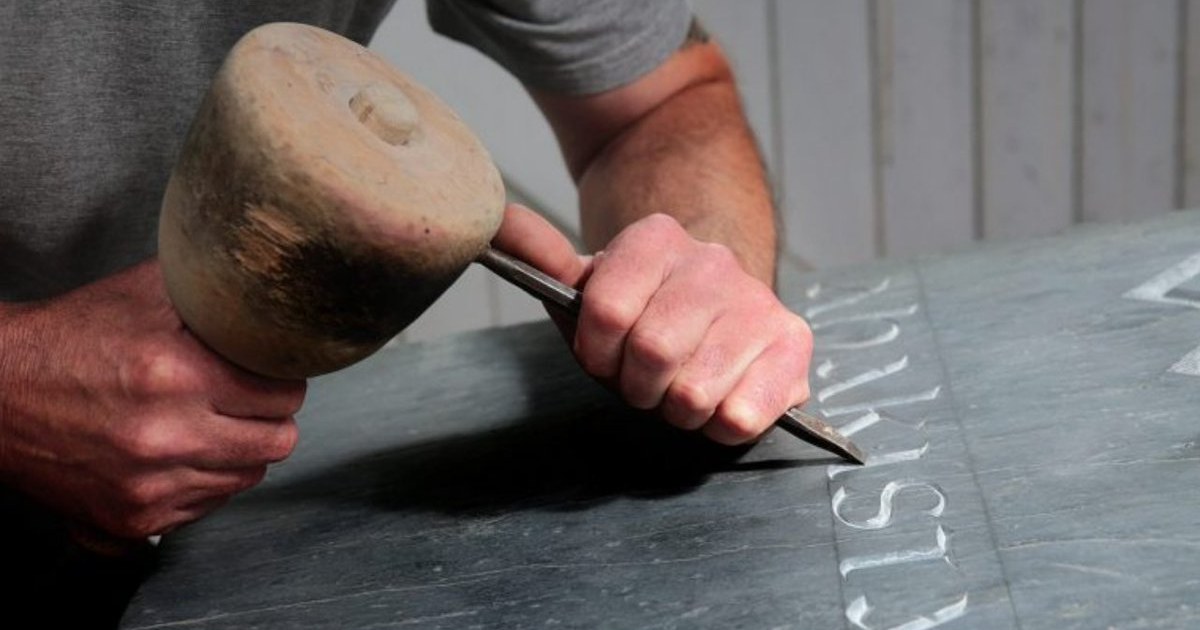
Hew thee. This time, Moses cuts the stone.

The first covenant came down as a pure gift: God's stone, God's writing. The second one asked something of the man carrying it. God would still do the writing, because no human hand could do that part. But Moses had to bring the stone.

The Climb with Blank Stones

I keep picturing Exodus 34:4: "And he hewed two tables of stone like unto the first; and Moses rose up early in the morning, and went up unto mount Sinai, as the Lord had commanded him, and took in his hand the two tables of stone."

He climbed that mountain carrying blank rock.

Anyone who has tried to come back after breaking something sacred knows what that climb feels like. You aren't carrying anything impressive. You've done the small, unglamorous work: the apology, the bishop's office, the first honest prayer in months, the decision to go back to the temple. You've shaped the stone as well as you could, and it is blank. You can't write on it yourself. All you can do is carry it up and hope He'll meet you.

Elder Jeffrey R. Holland once put it in words that read like a commentary on this verse:

"So if you have made covenants, keep them. If you haven't made them, make them. If you have made them and broken them, repent and repair them. It is never too late so long as the Master of the vineyard says there is time." (The Laborers in the Vineyard, April 2012)

Repent and repair them. That is Moses with a chisel at the foot of the mountain.

And God does meet him. What happens at the top is the part I think we miss.

What God Said the Second Time

Back up one chapter. After the calf, after Moses' remarkable plea, "if thou wilt forgive their sin—; and if not, blot me, I pray thee, out of thy book" (Exodus 32:32), Moses makes one of the boldest requests in the Old Testament:

"I beseech thee, shew me thy glory." (Exodus 33:18)

On the second trip up the mountain, God answers that request. Here is how He shows His glory:

"And the Lord passed by before him, and proclaimed, The Lord, The Lord God, merciful and gracious, longsuffering, and abundant in goodness and truth." (Exodus 34:6)

Moses asked for glory, and God described His mercy.

Look at the sequence. The first time on Sinai, Israel heard thunder, saw lightning, and backed away in terror (Exodus 20:18–19). The first tablets came wrapped in fire and smoke. Only after the covenant had been shattered, after a stiffnecked people had proved exactly how stiffnecked they were, did God stand next to Moses in the cloud and say, in effect: This is My name. This is who I am. Merciful. Gracious. Slow to anger. Overflowing with covenant love.

The phrase "abundant in goodness" carries the Hebrew word hesed, the loyal covenant love that Elder Matthew S. Holland recently described, following President Nelson, as "loyal, untiring, inexhaustible" (Forsake Not Your Own Mercy, October 2025). It wasn't absent from the first giving of the law; the Ten Commandments promise "mercy unto thousands" (Exodus 20:6), and that mercy is hesed. But there it was a clause tucked inside a commandment. Here, after the failure, God makes it His name.

God's fullest description of Himself on Sinai comes after the failure, not before it.

I don't think that's an accident. You can't fully reveal mercy to people who don't yet know they need it. Israel had to learn what they were capable of before they could hear what God was capable of.

And the God who passed before Moses proclaiming mercy was Jehovah, Jesus Christ, the same Lord who would one day write His law not on stone but "in fleshy tables of the heart" (2 Corinthians 3:3).

The Name That Echoes

Once you know this passage, you start hearing it across the whole Old Testament. Prophets and psalmists keep returning to Exodus 34:6 the way we return to a hymn we know by heart.

My favorite echo is the most reluctant one. Jonah, sulking outside Nineveh after the city repents, quotes this verse to God as a complaint:

"For I knew that thou art a gracious God, and merciful, slow to anger, and of great kindness, and repentest thee of the evil." (Jonah 4:2)

Jonah ran to Tarshish because he had read Exodus 34. He knew what God would do with second chances, and it made him furious that God would extend them to people he didn't like. In that same conference address, Elder Holland drew on Jonah's story to invite each of us not to forsake the mercy God holds out, even when our troubles are of our own making.

Sometimes the hardest version of this doctrine isn't believing God will give me a second set of tablets. It's watching Him give one to someone else.

Whose Face Shone

Moses came down from Sinai twice with tablets. After the first descent, the text says nothing about his appearance. After the second:

"When Moses came down from mount Sinai with the two tables of testimony in Moses' hand … Moses wist not that the skin of his face shone while he talked with him." (Exodus 34:29)

His face shone the second time. It came after the stones he carved himself, after he heard God's name declared as mercy, and after he stood in the cloud with a God who had every reason to give up on His people and didn't.

He didn't even know it was happening.

The Honest Part

I want to be careful here, because there's a cheap version of this message, and the Restoration won't let us get away with it.

The second tablets were not identical to the first. Joseph Smith's inspired translation of Exodus 34 tells us the Lord said He would write "the words of the law, according as they were written at the first on the tables which thou brakest; but it shall not be according to the first, for I will take away the priesthood out of their midst; therefore my holy order, and the ordinances thereof, shall not go before them" (JST, Exodus 34:1–2). The Joseph Smith Translation of Deuteronomy 10:2 says the same: the new tablets carried everything from the first, "save the words of the everlasting covenant of the holy priesthood" (JST, Deuteronomy 10:2).

Broken covenants have real consequences. Israel received a lesser law, "the law of carnal commandments," administered by the lesser priesthood (see Doctrine and Covenants 84:17–27). The pain of that loss lasted generations.

But look at what the lesser law was. It wasn't abandonment. It was "the preparatory gospel" (D&C 84:26), a schoolmaster to bring a people who couldn't yet bear God's presence to the point where they could (Galatians 3:24). God didn't respond to the broken stones by walking away. He responded with a slower road that still led home, and He proclaimed His mercy right in the middle of that hard news.

That's the honest version. Restoration isn't always instant, and it isn't always identical. But it is always toward Him.

What Went into the Ark

One last detail stays with me, and it comes from outside our canon.

When Moses later retells the story, the Lord's instruction about the new tablets ends with a simple command: "and thou shalt put them in the ark" (Deuteronomy 10:2). The ancient rabbis asked a question I had never thought to ask. What happened to the pieces of the first ones?

The Babylonian Talmud gives their answer (Berakhot 8b; cf. Menachot 99a, Bava Batra 14b). Nobody swept the fragments into the dust at the foot of Sinai. They went into the ark too. Luchot v'shivrei luchot munachin ba'aron: "the tablets and the fragments of the tablets lie together in the ark."

The rabbis used that image to teach something tender. If an old scholar forgot his learning through illness or age, he was still to be honored, because you don't throw away broken tablets. Elsewhere the Talmud adds a detail that moves me. Rav Yosef, one of the teachers who passed on this tradition, later fell ill and lost what he had learned. His student Abaye restored it by reviewing with him the very things Abaye had first learned from Rav Yosef (Nedarim 41a).

This is tradition, not scripture, and I hold it that way. But look at where the ark sat. Its lid was the mercy seat (Exodus 25:21), where once a year the high priest sprinkled the blood of atonement (Leviticus 16:14–15). In the Talmud's picture, the whole tablets and the broken ones lay together in the dark, directly beneath that seat.

The Lord doesn't ask us to pretend the first tablets never existed. He keeps the broken pieces with the whole ones and carries all of it with Him through the wilderness.

If you're standing at the bottom of the mountain right now with pieces of something sacred at your feet, here is what Exodus 34 offers. The first tablets showed Israel God's law. The second showed them God's heart. So pick up the chisel and carry the blank stone up the mountain. He will write on it. And when you come down, He won't make you leave the broken pieces behind. He has a place for them, right where His mercy rests.

Discussion Questions

  1. The first tablets were entirely God's work, but Moses had to cut the stone for the second set. What 'blank stones' has the Lord asked you to bring to Him when you came back after something sacred was broken?
  2. Moses asked to see God's glory, and God answered by describing His mercy. Why might God have waited until after Israel's failure to declare His name this fully?
  3. Jonah quoted Exodus 34:6 as a complaint because he didn't want Nineveh to get a second chance. When is it harder to accept God's mercy for someone else than for yourself?
  4. The second tablets brought real losses, including a lesser law and the removal of the higher priesthood, yet God still called that law a 'preparatory gospel.' How can we accept the consequences of broken covenants and still trust that the road leads back to Him?
Was this helpful?
← Back to all articles

TruthLock™ Verification

GOLD/AMBER
All 29 verifiable claims confirmed · 1 personal/interpretive not scored
Verified
Exodus 32:16 says the tables were the work of God and the writing was the writing of God, graven upon the tables.
Exodus 32:16 states the tables were the work of God and the writing was the writing of God, graven upon the tables.
Verified
Exodus 31:18 says Moses received two tablets written with the finger of God.
Exodus 31:18 says God gave Moses two tables of testimony, tables of stone, written with the finger of God.
Verified
Exodus 32:19 says Moses' anger waxed hot, and he cast the tables out of his hands and brake them beneath the mount.
Exodus 32:19 states Moses' anger waxed hot, and he cast the tables out of his hands and brake them beneath the mount.
Verified
Exodus 34:1 records the Lord telling Moses to hew two tables of stone like the first, and that the Lord would write upon them the words of the first tables.
Exodus 34:1 records the Lord commanding Moses to hew two tables like the first and promising to write on them the words that were in the first tables.
Verified
Exodus 34:4 says Moses hewed two tables of stone like the first, rose early, went up Sinai as the Lord commanded, and took the two tables in his hand.
Exodus 34:4 says Moses hewed two tables like the first, rose up early, went up Sinai as the Lord commanded, and took the two tables in his hand.
Verified
Elder Jeffrey R. Holland said in April 2012 in The Laborers in the Vineyard: So if you have made covenants, keep them. If you haven't made them, make them. If you have made them and broken them, repent and repair them.
Elder Holland's April 2012 general conference talk "The Laborers in the Vineyard" contains this exact quote: "So if you have made covenants, keep them. If you haven't made them, make them. If you have made them and broken them, repent and repair them."
Verified
After the golden calf, Moses pleaded with God, asking to be blotted out of the book if God would not forgive the people's sin (Exodus 32:32).
Exodus 32:32 records Moses asking God to forgive the people's sin, and if not, to blot him out of His book.
Verified
Exodus 33:18 records Moses asking God to show him His glory.
Exodus 33:18 records Moses saying, 'I beseech thee, shew me thy glory.'
Verified
Exodus 34:6 records the Lord passing before Moses and proclaiming that He is merciful, gracious, longsuffering, and abundant in goodness and truth.
Exodus 34:6 records the Lord passing by before Moses and proclaiming Himself merciful, gracious, longsuffering, and abundant in goodness and truth.
Verified
Exodus 20:18-19 records that Israel heard thunder, saw lightning, and backed away in terror at Sinai.
Exodus 20:18-19 says the people saw the thunderings and lightnings, removed and stood afar off, and feared that God's voice would kill them, which supports the paraphrase.
Verified
Exodus 20:6 says the Ten Commandments promise mercy unto thousands.
Exodus 20:6, part of the Ten Commandments passage, promises mercy unto thousands of them that love God and keep His commandments.
Verified
Elder Matthew S. Holland recently described hesed, the loyal covenant love, following President Nelson, as loyal, untiring, inexhaustible, in the October 2025 general conference talk Forsake Not Your Own Mercy.
Elder Matthew S. Holland's October 2025 talk "Forsake Not Your Own Mercy" calls hesed God's covenantal love and describes it as "loyal, untiring, inexhaustible". Footnote 13 credits President Nelson ("The Everlasting Covenant," Oct. 2022) for that description.
Verified
The God who passed before Moses in Exodus 34 was Jehovah, Jesus Christ.
Church teaching holds that Jehovah, the God of the Old Testament who dealt with Moses and Israel, is the premortal Jesus Christ. Exodus 34:5-7 says "the Lord" (Jehovah) passed before Moses, so the claim is consistent with that teaching.
Verified
2 Corinthians 3:3 speaks of the law written not on stone but in fleshy tables of the heart.
2 Corinthians 3:3 describes the Saints as the epistle of Christ written 'not in tables of stone, but in fleshy tables of the heart'; the verse names the 'epistle of Christ' rather than 'the law,' but the stone-tablet contrast evokes the law, so the claim's summary preserves the verse's meaning.
Verified
Jonah 4:2 records Jonah quoting to God that God is a gracious and merciful God, slow to anger, of great kindness, and repents of evil.
Jonah 4:2 records Jonah praying to the Lord, 'I knew that thou art a gracious God, and merciful, slow to anger, and of great kindness, and repentest thee of the evil,' which matches the claim.
Opinion
Jonah ran to Tarshish because he had read Exodus 34 and knew what God would do with second chances.
Authorial interpretation — not a verifiable factual claim.
Verified
In the same October 2025 conference address, Elder Holland drew on Jonah's story to invite members not to forsake the mercy God holds out.
The Jonah talk, "Forsake Not Your Own Mercy," was given at the October 2025 general conference by Elder Matthew S. Holland of the Seventy. He retells Jonah's story and urges listeners to "forsake not your own mercy." The claim does not say which Elder Holland it means, and it calls this the "same address," but it is a separate talk from Elder Jeffrey R. Holland's "And Now I See" (which does not mention Jonah). The content is accurate if the claim means Matthew S. Holland, and wrong if it means Jeffrey R. Holland.
Verified
Exodus 34:29 records that when Moses came down from Sinai with the two tables of testimony, the skin of his face shone while he talked with the Lord.
Exodus 34:29 records that Moses came down from Sinai with the two tables of testimony and that the skin of his face shone while he talked with him (the Lord).
Verified
Joseph Smith's inspired translation of Exodus 34:1-2 says the Lord would write the words of the law but not according to the first, because He would take the priesthood out of their midst.
JST Exodus 34:1-2 says the Lord would write the words of the law on the new tablets, but "it shall not be according to the first, for I will take away the priesthood out of their midst," which matches the claim.
Verified
The Joseph Smith Translation of Deuteronomy 10:2 says the new tablets carried everything from the first except the words of the everlasting covenant of the holy priesthood.
JST Deuteronomy 10:2 reads, "I will write on the tables the words that were on the first tables, which thou brakest, save the words of the everlasting covenant of the holy priesthood." This matches the claim, and the Old Testament Student Manual makes the same point.
Verified
Israel received a lesser law, the law of carnal commandments, administered by the lesser priesthood (D&C 84:17-27).
D&C 84:18 and 84:26 confirm that the lesser (Aaronic) priesthood was conferred on Aaron's seed and continued, holding the key of the preparatory gospel; the phrase 'law of carnal commandments' comes from verse 27, which is within the cited range but not shown in the excerpt.
Verified
The lesser law was the preparatory gospel (D&C 84:26), not abandonment.
D&C 84:26 states that the lesser priesthood 'continued' and holds the key of the 'preparatory gospel,' which supports describing the lesser law as preparatory rather than an abandonment of Israel.
Verified
Galatians 3:24 describes the law as a schoolmaster to bring a people to Christ.
Galatians 3:24 states 'the law was our schoolmaster to bring us unto Christ,' which matches the claim; 'a people' in place of 'us' keeps the meaning.
Verified
Deuteronomy 10:2 records the Lord's command to put the new tablets in the ark.
Deuteronomy 10:2 records the Lord saying He will write on the tables the words of the first tables and adds 'thou shalt put them in the ark.'
Verified
The Babylonian Talmud (Berakhot 8b; cf. Menachot 99a, Bava Batra 14b) teaches that the fragments of the first tablets were also placed in the ark.
Bava Batra 14b states that 'the tables and the fragments of the tables were deposited in the ark' (via Rav Huna and Rav Yosef's exposition of Deut. 10:2), which supports the claim; the cited Berakhot 8b and Menachot 99a parallels do not appear in the provided evidence but do not change the verified teaching.
Verified
The Talmud states that the tablets and the fragments of the tablets lie together in the ark.
Bava Batra 14b records Rav Huna and Rav Yosef teaching 'luchot v'shivrei luchot munachin ba'aron,' meaning both the second tablets and the broken pieces of the first tablets were placed in the Ark.
Verified
The rabbis taught that an old scholar who forgot his learning through illness or age was still to be honored.
BT Berakhot 8b, as quoted with Rashi's commentary, instructs respect for an elder who forgot his learning because of circumstances beyond his control, such as illness, and the evidence places this in the context of old age, comparing him to the broken tablets kept in the Ark.
Verified
Rav Yosef fell ill and lost what he had learned, and his student Abaye restored it by reviewing with him what Abaye had first learned from Rav Yosef (Nedarim 41a).
Nedarim 41a, as quoted in the evidence, states that Rav Yosef fell ill and his studies were forgotten, and that Abaye restored them by reviewing before him what he had learned from Rav Yosef.
Verified
Exodus 25:21 states that the lid of the ark was the mercy seat.
Exodus 25:21 instructs that the mercy seat be put 'above upon the ark,' which supports describing it as the ark's lid.
Verified
Leviticus 16:14-15 records that once a year the high priest sprinkled the blood of atonement on the mercy seat.
Leviticus 16:14-15 describes the high priest sprinkling the blood of the bullock and the sin-offering goat on the mercy seat, which supports the core claim; the 'once a year' timing is not in these verses but reflects the Day of Atonement context stated later in the same chapter (Lev. 16:34), so it is an accurate contextual summary.
Learn more about TruthLock™ →