Blog

The Red Sea Didn't Part Until They Stepped Into It

TruthLock™ Verified — GOLD/AMBER
Proof of Authentication — T8VK5ATU
Share
The Red Sea Didn't Part Until They Stepped Into It

"The sea opens in its own moment. But it opens for feet in motion."

Was this helpful?

The Two Commands That Contradict Each Other

Read Moses's words carefully and you'll notice something strange.

On the shore of the Red Sea, with Pharaoh's chariots closing in, Moses tells the people: "Fear ye not, stand still, and see the salvation of the Lord. … The Lord shall fight for you, and ye shall hold your peace" (Exodus 14:13–14).

Stand still. Hold your peace. Let God handle it.

And then, two verses later, the Lord says something that ought to stop every careful reader cold: "Wherefore criest thou unto me? speak unto the children of Israel, that they go forward" (Exodus 14:15).

Go forward. Into the sea. The sea that has not yet parted.

Moses told them one thing. The Lord told Moses something that sounds like the opposite. Which is it?

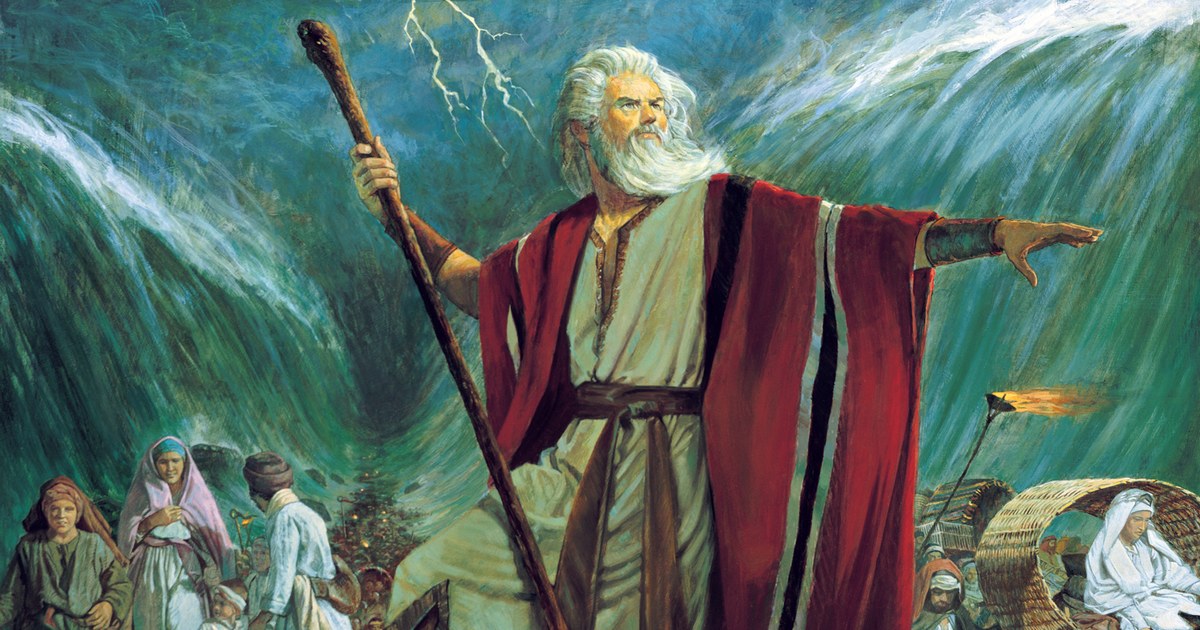
The Sea Did Not Part Until They Stepped Toward It

The Old Testament Seminary Teacher Resource Manual catches something most lesson helps skip over. Commenting on verse 15, it observes: "Notice that the first command in the miracle, before the water even started to part, was 'go forward.' This suggests that faith precedes the miracle" (Old Testament Seminary Teacher Resource Manual, "Exodus 14–15").

The Red Sea does not open and then the Israelites walk through a dry corridor. The Israelites step toward water that is still liquid, still impassable, still killing. The parting comes as they move.

And here's where the paradox resolves. "Stand still" in Hebrew is yatsab, and it doesn't mean do nothing. The Brown-Driver-Briggs lexicon glosses it as "set or station oneself, take one's stand." It's used elsewhere for someone taking up a watchpost or planting themselves at a fixed place. Moses isn't telling the people to go limp. He's telling them to take their stand. "Hold your peace" is charash — be silent, keep quiet — and Rashi's reading of it is striking: the Israelites should stop crying out in prayer because the time for prayer had passed. This was a moment for action and trust. Stand your ground. Stop arguing with the situation. Then, when the Lord says go — move.

Elder Jeffrey R. Holland used this scene to urge Saints not to cast away their confidence when the answer doesn't come on schedule ("Cast Not Away Therefore Your Confidence," BYU devotional, March 2, 1999). The sea opens in its own moment. But it opens for feet in motion.

The Church's seminary curriculum cross-references verse 15 — "speak unto the children of Israel, that they go forward" — to Doctrine and Covenants 8:2–3, where the Lord tells Oliver Cowdery that He speaks to us "in your mind and in your heart, by the Holy Ghost." I don't think the manual is claiming Moses received his instruction the way Oliver did. Moses was in direct conversation with the Lord; Oliver was learning to recognize a still small voice. But the pattern the cross-reference is pointing to is the same one: revelation precedes action. The Lord speaks, and then a prophet turns around and asks a million people to trust the word with their feet.

The Pattern Repeats

If chapter 14 were the only time this happened, it would be a story. It isn't. The same shape — act before the deliverance comes, and the deliverance comes through the acting — shows up four more times in the next four chapters. Once you see it in the Red Sea, the wilderness narratives stop feeling like a collection of anecdotes and start feeling like the Lord drilling one lesson into a nation that had spent four hundred years forgetting it.

At Marah, the water is bitter. The people have been three days in the wilderness without water, and "when they came to Marah, they could not drink of the waters of Marah; for they were bitter" (Exodus 15:23). Moses cries to the Lord, and the Lord shows him a tree — "which when he had cast into the waters, the waters were made sweet" (v. 25). Notice the shape of it. The tree doesn't fly into the water on its own. The water doesn't sweeten itself while Moses watches. He has to see the tree, pick it up, carry it to the water, and throw it in. Only then does the bitterness change. The miracle requires a prophet willing to get his hands on a tree and throw it.

In chapter 16, the Lord rains bread from heaven — with instructions to gather only enough for one day. When some tried to hoard it, "it bred worms, and stank" (Exodus 16:20). Elder D. Todd Christofferson once pointed out what a strange arrangement this is. The Lord had just performed the most spectacular deliverance in human memory. He could have filled their storehouses for forty years in one night. Instead He chose a method that required them to walk out and gather, morning after morning, for forty years — and the gathering itself was the lesson.

"As we seek and receive divine bread daily," Elder Christofferson said, "our faith and trust in God and His Son grow" (D. Todd Christofferson, "Give Us This Day Our Daily Bread," CES Fireside, January 9, 2011). The manna wasn't just food. It was a forty-year tutorial in going forward before the sea parts.

Chapter 17 does it again. The people thirst. Moses is told to strike a rock — not to pray more, not to wait — to strike. Water comes. And Paul would later tell the Corinthians, with that breathtaking casualness of his, that "that Rock was Christ" (1 Corinthians 10:4). The Rock that followed them. The Rock that was already there, under the dust, waiting for a rod and a prophet willing to raise his arm.

Why Moses's Arms Get Tired

Then Amalek attacks, and we get the strangest image in the whole reading. Moses on a hilltop, arms raised, and Israel prevails only as long as those arms stay up. "But Moses' hands were heavy; and they took a stone, and put it under him, and he sat thereon; and Aaron and Hur stayed up his hands, the one on the one side, and the other on the other side" (Exodus 17:12).

The usual reading of this is about sustaining the prophet, and that reading is correct. But sit with what the scene says about Moses himself.

The man who parted the Red Sea gets tired. The prophet of God has arms that grow heavy. The same Moses who called down plagues on Egypt cannot hold his own hands in the air by himself for one afternoon. He needs a stone to sit on. He needs two men on either side. The prophet of the Exodus — the one who stretched his rod over the sea — can't finish the day without help.

And then chapter 18 arrives, almost as if on cue, with Jethro — Moses's father-in-law, a priest of Midian — watching Moses try to judge every dispute in Israel from sunup to sundown. Jethro says what Aaron and Hur showed: "Thou wilt surely wear away, both thou, and this people that is with thee: for this thing is too heavy for thee; thou art not able to perform it thyself alone" (Exodus 18:18).

Too heavy. The same word, really, as Moses's hands. The prophet of the Exodus is surrounded by people God brought into his life to hold up his arms — a brother, a friend, a father-in-law, seventy elders. The Lord delivers Israel from Pharaoh in spectacular fashion in chapter 14. Then He spends four chapters teaching Moses that he cannot carry Israel alone, and was never meant to.

The Thread

Centuries after the Exodus, Nephi stood in front of brothers who wanted to quit and said this: "Let us be strong like unto Moses; for he truly spake unto the waters of the Red Sea and they divided hither and thither, and our fathers came through, out of captivity, on dry ground" (1 Nephi 4:2). Notice what he remembers. Not a miracle God did to them. A miracle God did through a prophet who spoke and feet that walked. That's the Book of Mormon's own reading of Exodus 14, and it's the thread running through all five chapters: God's deliverance is real, and it requires you to move.

Stand still — meaning, stop panicking. Then go forward — meaning, step into the water. Gather the manna — every day, not once. Strike the rock — don't just look at it. Raise your hands — and when they get heavy, let someone hold them up. Delegate the burden — because the work is too heavy for one person and it always was.

The Israelites who died in Egypt were the ones who never left. The Israelites who died in the wilderness were the ones who refused to gather, refused to trust, refused to move when the cloud moved. The ones who made it were not the ones with the most faith. They were the ones who, with whatever particle of faith they had, kept taking the next step.

Most of us aren't standing on a literal shore. But the shape shows up anyway. A woman sits in an oncologist's office and is told the treatment has a protocol, and the protocol requires her to show up every week for months, and no one can tell her in advance whether it will work. A man looks at a marriage he's let drift for a decade and realizes the only way back is a conversation he has been avoiding for half that long. A parent watches a child walk a path the parent is powerless to redirect, and has to decide whether to keep showing up or pull away in self-protection. In each case the sea is real. The chariots are real. The instruction is the same: stand your ground, then move. The parting, if it comes, comes during the walking.

Go forward anyway. That is how the Lord saves Israel.

Discussion Questions

  1. Where in your life right now is the Lord asking you to 'go forward' before the path is clear? What would stepping into the water look like this week?
  2. The Hebrew word for 'stand still' (yatsab) means to set or station yourself — to take your stand, not to go limp. How does that change the way you've read Exodus 14:13?
  3. Moses needed Aaron and Hur to hold up his arms, and Jethro to redistribute the burden. Who are the people God has placed in your life to 'stay up your hands,' and whose hands are you holding up?
  4. The manna spoiled if hoarded. Why do you think the Lord designed spiritual nourishment to require daily gathering rather than one-time storage?
  5. Nephi remembered the Red Sea not as something God did to the Israelites but as something God did through them. What does that distinction change about how you think of your own deliverance stories?
Was this helpful?
← Back to all articles

TruthLock™ Verification

GOLD/AMBER
All 22 verifiable claims confirmed · 10 personal/interpretive not scored
Verified
Moses told the Israelites at the Red Sea to stand still and hold their peace, letting God fight for them (Exodus 14:13-14).
Exodus 14:13-14 confirms Moses told Israel to fear not, stand still, and hold their peace while the Lord fights for them.
Verified
Two verses later, the Lord commanded Moses to tell the children of Israel to go forward into the sea (Exodus 14:15).
Exodus 14:15 records the Lord telling Moses to speak to the children of Israel that they go forward.
Verified
The Old Testament Seminary Teacher Resource Manual observes that the first command in the Red Sea miracle, before the water parted, was 'go forward,' suggesting faith precedes the miracle.
The Old Testament Seminary Teacher Resource Manual (2003) contains the exact language cited: under Verse 15 it states, 'Notice that the first command in the miracle, before the water even started to part, was
Opinion
The Red Sea did not part before the Israelites stepped toward it; the parting came as they moved.
Authorial interpretation — not a verifiable factual claim.
Verified
In Hebrew, 'stand still' (yatsab) means to set or station oneself and take one's stand, not to do nothing.
Multiple authoritative Hebrew lexicons (Strong's, Brown-Driver-Briggs, NAS Exhaustive Concordance) unanimously confirm that yatsab (H3320) means 'to set or station oneself, take one's stand' — an active, deliberate positioning — not passive inaction, exactly as the claim states.
Verified
The Brown-Driver-Briggs lexicon glosses 'yatsab' as 'set or station oneself, take one's stand.'
Multiple sources citing Brown-Driver-Briggs confirm that yatsab (יָצַב) is defined as 'to set or station oneself, take one's stand.'
Verified
'Hold your peace' (charash) means to be silent and keep quiet.
Strong's H2790 (charash) is translated as 'hold peace,' 'keep silence,' 'be silent,' and 'hold tongue,' confirming the meaning of being silent and keeping quiet.
Verified
Rashi's reading is that the Israelites should stop crying out in prayer because the time for prayer had passed and it was a moment for action and trust.
Multiple sources confirm Rashi's interpretation that Hashem told Moshe this was not the time for lengthy prayer but for immediate action, as Israel was in distress.
Verified
Elder Jeffrey R. Holland used the Red Sea scene to urge Saints not to cast away their confidence when the answer doesn't come on schedule in a BYU devotional on March 2, 1999.
The claim is fully confirmed: Elder Jeffrey R. Holland delivered the BYU devotional 'Cast Not Away Therefore Your Confidence' on March 2, 1999, in which he prominently used the Red Sea scene (drawing on D&C 8:2–3 and Exodus 14) to urge Saints not to cast away their confidence — including when answers or promised blessings don't come on schedule — with the talk's central message being 'Don't panic and retreat. Don't lose your confidence.'
Verified
The Church's seminary curriculum cross-references Exodus 14:15 to Doctrine and Covenants 8:2-3, where the Lord tells Oliver Cowdery that He speaks to us 'in your mind and in your heart, by the Holy Ghost.'
Multiple Church seminary manuals (including the Old Testament Home-Study Seminary Student Guide and the Old Testament Seminary Teacher Resource Manual) explicitly cross-reference Exodus 14:15 to D&C 8:2–3, noting that Moses received revelation 'in the mind and the heart by the power of the Holy Ghost,' and D&C 8:2 itself reads 'I will tell you in your mind and in your heart, by the Holy Ghost,' exactly as the claim states.
Opinion
The pattern shown in Exodus 14 is that revelation precedes action, with the Lord speaking and then a prophet asking people to trust the word with their feet.
Authorial interpretation — not a verifiable factual claim.
Opinion
The same pattern of acting before deliverance comes appears four more times in the next four chapters of Exodus.
Authorial interpretation — not a verifiable factual claim.
Verified
At Marah, the water was bitter and the people could not drink it after three days in the wilderness (Exodus 15:23).
Exodus 15 recounts the bitter waters of Marah after three days in the wilderness, consistent with the claim.
Verified
The Lord showed Moses a tree which, when cast into the bitter waters of Marah, made the waters sweet (Exodus 15:25).
Exodus 15:25 states the Lord showed Moses a tree which, cast into the waters, made them sweet.
Opinion
The miracle at Marah required Moses to see the tree, pick it up, carry it to the water, and throw it in.
Authorial interpretation — not a verifiable factual claim.
Verified
In Exodus 16, the Lord rained bread from heaven with instructions to gather only enough for one day.
Exodus 16 describes manna rained from heaven with instructions to gather daily, consistent with verse 20 noting some kept it overnight contrary to instruction.
Verified
When some tried to hoard the manna, it bred worms and stank (Exodus 16:20).
Exodus 16:20 confirms that leftover manna bred worms and stank.
Verified
Elder D. Todd Christofferson pointed out that the Lord chose a method of providing manna that required the Israelites to walk out and gather morning after morning for forty years, and the gathering itself was the lesson.
Elder D. Todd Christofferson's BYU devotional 'Give Us This Day Our Daily Bread' (January 9, 2011) directly addresses the manna narrative, explaining that the Lord provided daily sustenance for 40 years requiring the Israelites to gather each morning, and that this method was designed to teach faith and trust in God — substantively confirming the claim that the gathering itself was the lesson, though the claim slightly condenses his teaching (he frames the lesson as building faith/trust rather than using the exact phrase 'the gathering itself was the lesson').
Verified
Elder D. Todd Christofferson said that as we seek and receive divine bread daily, our faith and trust in God and His Son grow, in a CES Fireside on January 9, 2011.
The exact quote 'As we seek and receive divine bread daily, our faith and trust in God and His Son grow' appears verbatim in Elder D. Todd Christofferson's CES Fireside address titled 'Give Us This Day Our Daily Bread,' delivered on January 9, 2011, at Brigham Young University — confirmed by multiple official Church and BYU sources.
Verified
In Exodus 17, Moses was told to strike a rock, and water came forth.
Exodus 17 records Moses striking the rock to bring forth water, a well-established scriptural account.
Verified
Paul told the Corinthians that 'that Rock was Christ' (1 Corinthians 10:4).
1 Corinthians 10:4 states 'that Rock was Christ,' confirming Paul's statement to the Corinthians.
Verified
In Exodus 17, when Amalek attacked, Israel prevailed only as long as Moses held his arms up.
Exodus 17:12 describes Aaron and Hur holding up Moses's hands, consistent with the account that Israel prevailed while his arms were raised.
Verified
Moses's hands became heavy during the battle with Amalek, and Aaron and Hur held up his hands, one on each side (Exodus 17:12).
Exodus 17:12 confirms Moses's hands were heavy and Aaron and Hur stayed up his hands, one on each side.
Opinion
Moses, the prophet of the Exodus who parted the Red Sea, could not hold his own hands in the air by himself for one afternoon and needed help from Aaron and Hur.
Authorial interpretation — not a verifiable factual claim.
Verified
In Exodus 18, Jethro, Moses's father-in-law and a priest of Midian, observed Moses trying to judge every dispute in Israel from sunup to sundown.
Exodus 18 records Jethro, priest of Midian and Moses's father-in-law, observing the burden of Moses judging alone, with verse 18 warning he would wear away.
Verified
Jethro told Moses that he would surely wear away, both he and the people with him, because the thing was too heavy for him and he was not able to perform it alone (Exodus 18:18).
Exodus 18:18 matches the claim's wording about wearing away and the task being too heavy to perform alone.
Opinion
The Lord delivered Israel from Pharaoh in chapter 14, then spent four chapters teaching Moses that he could not carry Israel alone and was never meant to.
Authorial interpretation — not a verifiable factual claim.
Verified
Nephi said to his brothers: 'Let us be strong like unto Moses; for he truly spake unto the waters of the Red Sea and they divided hither and thither, and our fathers came through, out of captivity, on dry ground' (1 Nephi 4:2).
The quotation matches 1 Nephi 4:2 exactly as cited.
Opinion
The Book of Mormon's reading of Exodus 14 emphasizes a miracle God did through a prophet who spoke and feet that walked, not a miracle God did to the people.
Authorial interpretation — not a verifiable factual claim.
Opinion
The Israelites who died in Egypt were the ones who never left.
Authorial interpretation — not a verifiable factual claim.
Opinion
The Israelites who died in the wilderness were the ones who refused to gather, refused to trust, or refused to move when the cloud moved.
Authorial interpretation — not a verifiable factual claim.
Opinion
The Israelites who made it through were not the ones with the most faith, but the ones who, with whatever particle of faith they had, kept taking the next step.
Authorial interpretation — not a verifiable factual claim.
Learn more about TruthLock™ →